The Witches Queen
& Others
Landcraft is practice to focus our attention in particular ways. It's not taxonomy for its own sake, and these categories are supposed to flow. The figure of the Witches Queen intertwines and overlaps with others on the map, and that is the topic of this page.
(In my lessons on trance I am learning that to slip away, one must try and hold two contradictory images or sensations or motions in the body at once, and perhaps that is the secret to Landcraft - to split out everything into contradictory components only to bring them together and feel in that dissonance the crack that opens the hidden world. When I try and pull these disparate images togther and hold them both at once, there's a rippling and tearing sensation)
Aspects
As in the rest of Fencraft, the Queen can appear in three guises. Under the Sun, she might be encountered as a mighty ancestor - some ancient witch who has stayed on as Guardian and goddess to teach those who follow. Under the Lunar, she may be a fairy or one of the dead, a not-human-but-person person who we encounter on a sort of equal ground. And under the star, it is the weird of witchcraft itself in its unmixed and incredible power, from wherever-whence it comes.
You might say the Lunar seems to cycle sideways. So far we have identified Solar spirits (a cycle of rise and fall) and uh maybe like, Tidal spirits (a single direction of greater and lesser, like the Sorceror or Seafarer, daring to tred or retreat but to go too far is annihilation).
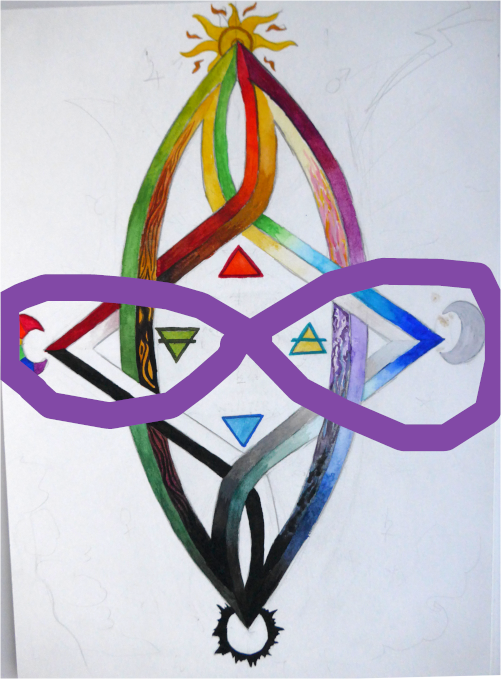
The Lunar does not diminish - it waxes and wanes, and yet those are differences rather than distinctions of degree. Imagine on the diagram a sideways motion, which takes in both crescents, stealing a little from the Solar and the Stellar but never touching either so close as to be dominated by it. It moves between the warm and cold paths, but is not limited to them either. It has an apex of reflecting either the light or dark, and yet it is but a reflection, not their unmixed true source (it is for this reason witches use the dark moon, a Stellar thing in a safer form, like looking at an eclipse only through a reflection box to spare the eyes)
Somewhat like the crude purple line on this:
Or, to be honest, this:
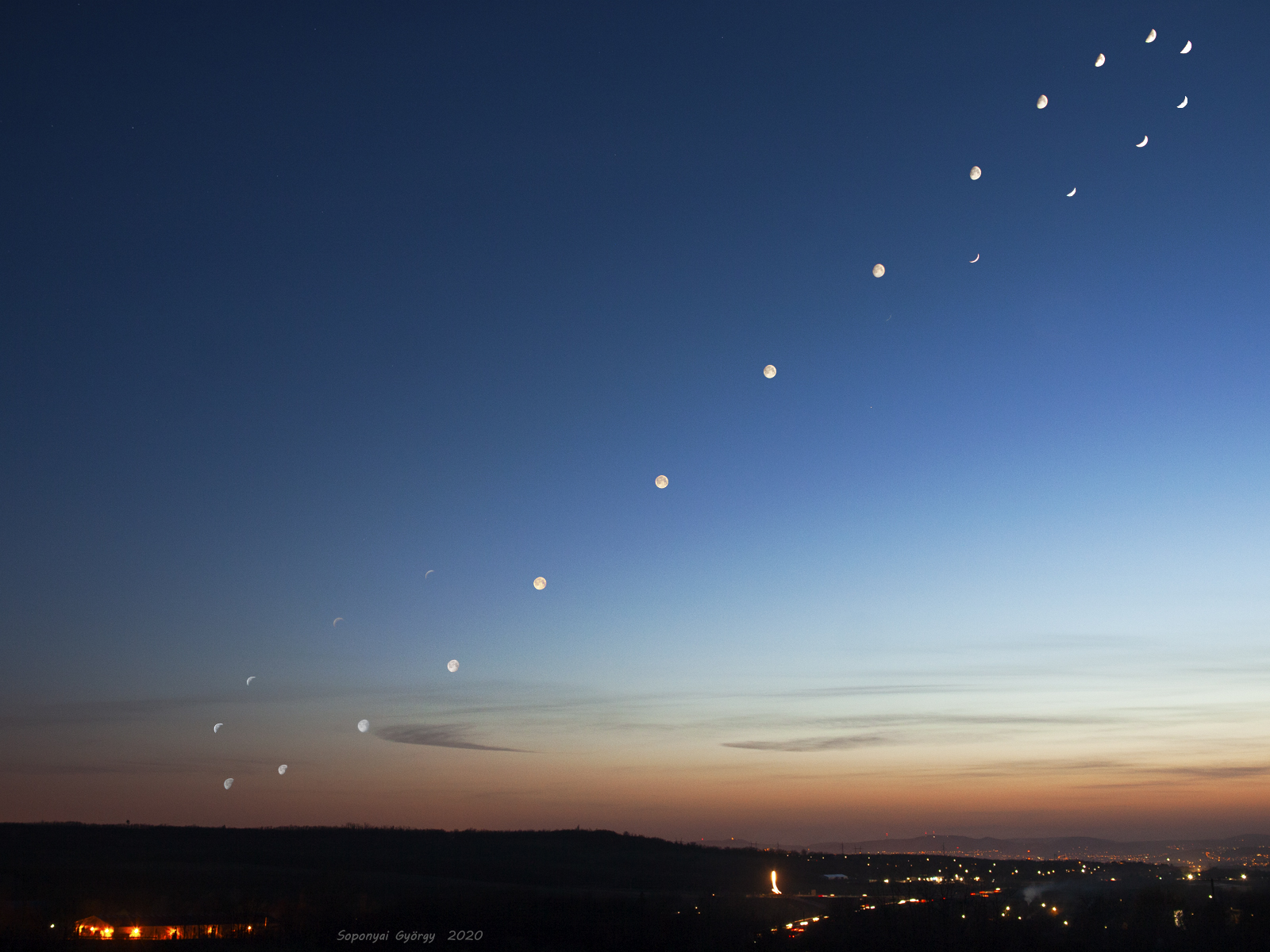
Explanation: An analemma is that figure-8 curve you get when you mark the position of the Sun at the same time each day for one year. But the trick to imaging an analemma of the Moon is to wait bit longer. On average the Moon returns to the same position in the sky about 50 minutes and 29 seconds later each day. So photograph the Moon 50 minutes 29 seconds later on successive days. Over one lunation or lunar month it will trace out an analemma-like curve as the Moon's actual position wanders due to its tilted and elliptical orbit. To create this composite image of a lunar analemma, astronomer Gyorgy Soponyai chose a lunar month from March 26 to April 18 with a good stretch of weather and a site close to home near Mogyorod, Hungary. Crescent lunar phases too thin and faint to capture around the New Moon are missing though. Facing southwest, the lights of Budapest are in the distance of the base image taken on March 27.
So the Witch is many coloured - on one apex she is blood-red-and-black glamour dancing beside the devil in the woodlands, and on the other she is midnight blue and white as the scholar in solitary pursuit; she can appear in the purple and yellow of the morning, laughing-bright and welcoming, and in the terror of the dark horizon and black-drifts across a grubby blue sky in a rushing of nightmares, and in the turquoise-dark of the midwife of the forbidden, the witch-fisher who wrecks ships at sea.
The Witch is a moon passing through all these phases in her turn, where she wills it, drawing her mastery not from these elemental positions themselves (for she is not natural and has no affinity to them) but from her own moon-magic through which all things are possible. She comes holding a prism.
Common aspects
- Center: the leader of a coven as mythic figure.
- Lunar-sanctuary: solitary scholar, sense of astronomy and books. Clear-feeling.
- Lunar-Stellar-sky: the Night Ride/Wild Hunt. The witch as nightmare among other horrors.
- Lunar-Stellar-sea: the midwife, the hekataean, the sea witch, involved with lunar-stellar magics such as birth, death, fate
- Solar-Stellar-woodland: the devil's coven. Ecstatic, worshipful, always in a group.
The Night Flight and the Wild Hunt
Notice the paralelling across the Map. Between the Lunar and Stellar, the things of the wild and strange take control, driving the unwary further and further into a chaos which is more easily started than stopped.
On the Landishpath, this is the wild hunt - where all is turned to feral galloping, the ecstasy of beasts, the transformation from man to woman to beast to flame to food to hunter to hunted to forest to swamp to nothing to everything. Across cultures, it is some form of otherworld procession - perhaps the fae, perhaps the dead, perhaps the damned - but woe betide the mortal who encounters it.
On the Skyishpath, this is the night flight - where the witches arise from their slumbering in strange shapes, like black cloud-drifts across the moon, in spirit-forms and riding brooms, in a cacophony of wicked things, a vast billowing darker-than-dark, perhaps in datura-dreams alone, perhaps bodily, to the sabbath dance they go - qui hou hou, Marie Lihou, qui hou hou, Marie Lihou - Har har, hoo hoo dance ici, dance la, jous ici, jous la!
In drawing map after map, but with greater certainty, I have understood these as a pair - one across the land and one of the sky, one of the horned thing of the forest and one of his witches, or one of the dread things of the night and one of the crawling things of the undergrowth.
And the Lightbringer
The Witch Queen can be expressed as twins: the interplay of sun and moon, and the interplay of the light and dark moon, and perhaps the morning and the evening star. For it is baked deep into our witchcraft traditions that a coven is powered by the pair of a woman and a man - but we don't have to understand what's going on there as something gendered.
Fencraft has an interest in the Aradia myth - an origin story for the goddess-queen of witches, who is daughter of the twins Lucifer and Diana
(though I don't tend to go with the cosmic incest, even just as a metaphor. I percieve that in deity work, relationships are often a way of discussing an energy metaphor. For example, as in the Retinue, Frigg's maidens all seem to be aspects of Frigg's own nature. So to say two spirits are lovers or brothers or mother and child - well, these are not people.
Fencraft teaches spirits have three aspects, and in only one of these can we approach them as a kind of person who may indeed be in relationships with other people (the Lunar; and arguably too any ancestors). But in more of a God context or a Stellar context, using human relationship terms is an attempt to gesture at an interrelationship between two things that we can only point at through the terms we have to hand.
With this in mind, one often can approach the same two spirits as lovers - as siblings - as parent and child - as enemies - as mirrorfaces - as aspects - and in each approach, encounter something different. All the same, I think the non-reproductive nature of these two spirits is important to me, that they are not of earth or of the flesh, that they were not themselves born and cannot birth in their turn. & in general, I want to move away from core Pagan myths that are always sexual/reproductive - there is more than enough of this in our past to draw from.)
In what we do, neither of these figures are exactly Guardian-of-the-Green for the celestial bodies - it's not their job to roll the skyballs about - but there is something of each that expresses the other. They are spirits not of light but with a relationship to it, and as the light of sun and moon are the same, it is not surprising that they intertwine. Within Fencraft - in ways I can't quite name - it is clear that celestial light-energies is core to the nature of the universe of magic (light of sun and moon and star), and so of course: the figures who help us to access power over reality are easily mistaken for that light.
In that lore, Lucifer is god of both Sun and Moon. In mainstream witchcraft, Lucifer-Apollo is the sun while Diana-Artemis is the moon. In Germanic paganism, the genders are reversed - Máni and Sól; the same is true in Indo-European, Mēnōt and Sawélyosyo Dhugətḗr.
Fencraft is gender-agnostic - it's not centered around Gender Mysteries - but to me, this is expressive of an interrelationship. I tend to imagine both figures as gender-creative - the folklore of both Lucifer and Diana as queer figures, the one a languid ephebe and the other a strong-armed separatist dyke. There is, too, a certain genderlessness I associate with this sphere - it is the world of light, of air, of insubstantiality and of ideas, where both flesh-bodies and social systems cease to have meaning. I see between them an interchangeability - as in the Morning and the Evening star - one warmgolden, the other indigo, the same and separate.
There is, too, a desire to ungender magic. Unavoidably, our culture imagines men's magic and women's magic as distinct - I don't mean cultic roles within specific sects, but the instinctive vision of the rational and controlled vs the emotional and intuitive. The vision of twins, of the sun and moon cycling, of the ungendered man and ungendered woman, asks what if they were intermingled? There is a Lightbringer as teacher of magic, but perhaps it is as much Diana in her brother's face, a Gwydion-and-Arianrhod, their overlappingplace.
Diana brings through a new guise of the Lightbringer which is not present when he is alone - for the Lightbringer has no forested or cthonic attributions. Derived ultimately from Satanic strands, beside the Queen of the Witches he is the black goat, the Baphomet, the Gentleman in Black at the crossroads, a figure that is part of the facilitation through which we encounter witchcraft. In these pairings, she is the whirling of the Lunar around his Stellar, the interplay between control and the cthonic - he is the mystery, she the insight to penetrate it.
And the Adept
The Queen is positioned on the map between the Landish and Skyish - that is, between doing and experiencing. In a sense, she is the bridge between the Adept and the Changeling, synthesising mastery and self-loss, true mistress of magic.
The Queen overall represents an approach that's more religious. If the Adept represents any process by which you tap into magic and get results - the sort of reddit chaote who thinks of it as programming, for example, or the kind of tumblr witch who is over Wicca and recognises no spirits, no masters, but still does spells. The Queen speaks of reverence of witchcraft for its own sake, worship and celebration of its spirits, a religious expression in which spellcasting is its greatest and most intimate act.
The Adept has a narrative journey - a beginning and end - whereas for the Queen, it is more a matter of degree, emboding something greater that does not wax and wane. The Adept has a Solar nature. They are mortal - and is in either a cycle or a straight path. The Queen, evidently, is not. Where the Adept is NOT mortal, they are static (sol) - ageless and within their sphere, not changing and causing change. And theirs is more of a story of mortals - treading too far towards the Stellar brings damnation; whereas the Queen is more centered on the Lunar-Stellar, at home beside the abyss - it is, in part in accordance with her nature.
The Queen expresses her intertwining with the sun as being part of a group and comes with the gift of witchcraft, whereas the Adept is set-apart and solitary, often jealous of it.
Still, in practice - one can be an aspect of the other, as makes sense to you.
And the Changeling
There is a relationship here too - for in the lore, the Queen of the Witches and Queen of the Fairies figures often overlap, as does the Fairy King, the Lord of the Forest and the Devil.
Nontheless - I do feel they are distinct. I think the Changeling has more seasonal and elemental characteristics, the interplay of spring and autumn, and more of a symbol-story too, governing all sorts of things, from childhood to psychedelia. The Changeling is not, exactly, a spellcaster - she leads a dance, not a ritual. The magic of the witches queen seems to be Skyish in origin - between the moonlight and stars - while the Changeling is of the undergrowth and soil; and yet, in autumn, she can be a redrustling wind and sudden strangeness of stars as well. And the Changeling, being part-solar, is a story about a mortal becoming, falling, encountering and temptation; to my mind, the Queen of Witches is never not already a witch.
There is certainly an overlapping aspect, a kind of hedge-crossing-poison-witchery of the woodland folk, the ecstasy of magic where one might feel one had stepped onto a different path. Use whichever doorway takes you.
And the Winter Witch
In my storymythos, the Changeling is half-sister-by-adoption to Luciferdiana. They are all of the same 'generation' in the family tree - very close to the mortal, more storylike and human than mighty-distant spirits.
The Winter Witch - a Skyish thing, Lunar, associated with both coldness of winter and magic - makes two children alone, of her own craft (shades of the Virgin birth there, something inherently unnatural, insubstantial and metallic to both of them). Lucifer to be her inheritor, the perfect and betraying sun who has her seasonal qualities, light and darkness and the cold; and Diana his twin, who inherits her cleverness and talent for magic. Her step-child, the Changeling, is the daughter of some other fairy-queen and king-in-autumn, learning different magics from too many hours spent wandering alone in the woods, talking only to the wolves and trees.
Fancifully, I imagine them all as a set during March, considering the theme of children as in Narnia and the like, a vision of willful teenagers all refusing to become what they ought to be.
The Wiccan Goddess
For me, the God and Goddess of Wicca do too many things and - across their lifetime, invented and reinvented by each coven anew, have picked up too many resonances which hold no interest. The Triumph of the Moon was transformative for me, helping pry apart when certain tropes became associated with these figures. Nowadays, I find I feel a lot of kinship with 1950s witches (fertility stuff aside), seeing 1970s California feminist-political-empowerment witchcraft as the beginning of it being made unstrange (I'm not a Reclaiming person, for example - I'm turned off by New Ageiness)
Fencraft draws from centuries of weird Britannia, of which the New Forest coven are certainly part. I find it easier to encounter her as one polytheist spirit - a goddess, not the goddess. When you actually read the early stuff, it's clear that generic Wicca has drifted far from its original, earthy roots, into something that feels far more energetically 'clean'. An Aradia-Pan couple, the mistress of enchantments led by the bewitching moon and the shadow-finger-branches of the forgotten thing in the forest. That is what calls me. We never had to reinvent a traditional witchcraft to distinguish us from Wicca - merely to remember it.
The Wiccan Goddess is located between the Lunar and Stellar (Skyishpath). At the start, she is the chaste maiden of the moon in the Lunar Sanctuary, associated with healing and new growth; in Fencraft, usually appearing as the River Daughter, some figure embodying the fresh spring water under cool air. At her fullness, she is Lunar-Stellar as the blue night sky, all the abundance of magic, skill and brilliance. At her waning, she is the Hekataean, overlapping with our Fisher figure - mistress of strange magics, particlarly child-birth and child-death and things far beyond the dark veil, strange stars against a sky of black.
She can be here too - it does not preclude other goddesses.
On the Naming of Witches
This article has been so slow because 'Diana' does not speak to me.
I suppose I've been waiting for more information; but the spirits of Fencraft are, ultimately, symbol-keys. They are veils. They have been picked out of the rubble of history and folklore as beacons to follow, and if that process is all make-believe, what is beyond them is very real, for they have been recorded in parchment, swamp and stone.
Fencraft's quirks are responses to my blockages: when I read Scott Cunningham and hear about 'the God' or 'the four elements' and cannot see or feel them, I go hunting to rediscover them by new ways. In many ways, this is just Wicca, remixed to bring the drum line to the fore, looping up the horn section, adjusting down the treble and producing a new texture from an old tune. This is the Hendrix cover - perhaps only to my ears.
When I began this journey, I could never have imagined I would be a Great Goddess person - and yet She has always been here, the first thing I see in the morning as I look out my window and say welcome again to the strange wonder of clouded skies.
British folklore and mythology is intertwined with that of the Greeks and Romans because our historians saw those cultures as both respectable and important - and this process was going on as early as the Celtic period, where names like Sulis Minerva and Ogmios Hercules both reveal and obscure the true nature of the Gods. Scholars picked up on and amplified similarities; in an era where one-world-religion was fashionable anthropology, they saw Greco-Roman religion as the objectively correct pattern, and used it to fill in gaps in our fragmentary remains, and to argue that our lore was of equal dignity.
I think there is something in her classical image - statuesque as the untouchable moon - which shuts me out, when what I see and reach for is leading me to the wrong place. That Diana is present in our system (because it is a map of all things) - and she is present in a similar place. Landcraft is for teasing out these seperatnesses, for pulling a polytheism out of mythic morass. In the telephone directory of the infinite, I've been misdialing Diana A. when I meant to speak with Diana Q.
When our Leader of the Witches is called 'Diana', what did they mean? For that Diana-of-Fantasia, Diana-of-Rome is present as an aspect, and yet the spirit we call upon is more of a Venn Diagram of all her secret names: Hekate, Nicneven, Herodias, Morgana, Aradia, Habondia, Frau Holda. At the center of this labyrinth, we find her.
When I meditate upon Diana - blue and white - I hear a firm and stately no and then nothing, perhaps something She knew about my gender long before I did. She has always been a figure I can only really understand as a picture because I have no way beyond or within.
I get further in feeling my way towards her through her other qualities - the retinue of burnt witches and witch-ancestors, the following swarm of bats and goblins and strange things, the sensations of a frog-calling and cat-blinking, the Mother of Enchantments and the presence that evokes. That figure comes to me in purple, looking not a little like Doreen Valiente, both feet planted on the ground but surrounded by the swirling of all that she has become.