The Witches Queen
Mother of Enchantments
The master and mistress of magic,
They dwell in the deeps of the mind,
Immortal and ever-renewing,
With power to free or to bind.
Amongst the great unrecorded are the spirits of witchcraft - marginal things, like ghost forests that remain only in the shadows of their branches cast by no natural sun.
The queen of the witches and the woodland devil...the witch on the outskirts with his familiar spirit...the women dancing with the goat...the magician and his devils...
Fencraft rejects the core rites of Wicca's Religious Witchcraft - the fertility cult of One Goddess and One God - leaving a gap as to what witches do.
(indeed, on a larger scale, my biggest problem with modern paganism (as is) is: taking out Wicca's divine mystery without discovering a new heart. The mystery is its meaning. We may be enjoying the robes and spellcasting for its own sake, but that cannot be all it is - religion lifts our eyes to the beyond, wherever that may be, in the soil and beyond the stars. It needs the encounter with the infinite and the otherworldly - if only for a moment - a time outside of time when such things break through. If not the meeting of the God and Goddess - then what?)
In Fencraft, we try to approach everything as if it had a single aspect as a single, separate identity, so as to be sure of what we are encountering. When we consider the witch dance at the balefire, it suggests the spirits of witchcraft itself. The Landmother - our great goddess - is not a ruler of magic, and neither exactly is the Fisher or the Estes or the Changeling, although all are capable of preternatural action and great gifts.
This section is about the spirits of doing magic spells, celebrating that act as another spirit might celebrate the fruits of field-harvest, battle or craftsmanship. And though all pantheons and pathways have such spirits, who are tasked with the teaching of magic, I imagine the Queen of the Witches in this specific way: a Sabbat court meeting under the moon, to dance around the balefire and find strange ways through the stars. Here, we can be childish in our red striped stockings, and sinister.
The Queen of the Witches is called by your doing-of-witchcraft. She challenges our sense that we can do 'too much' magic - that doing so is greed, or likely to backfire, not our birthright, or that perhaps we have a bar of mana to run down or a limited stock of wishes we can use. Magic is her delight: you can, and should do more, as if she is not drained but made more mighty by it.
She is the High Priestess of our imagination - not as we will encounter her in our religious lives, but as we long to encounter her. You might see a parallel to the Sun King - he is the archetype of king all kings ought to be, and never are.
This figure forms a cycling pair with herself. The Queen of the Witches comes to us in her becoming - as ideal, but also as a mortal witch. She is both a mighty ancestor of the craft, and the embodiment of what we seek, the very ecstasy of magic. We work beside her as part of her retinue, or become her with the retinue around us, as she calls us to works of enchantment for her delight.
Witchcraft
The Witch Twins are a holding place for what is known as 'Traditional Witchcraft'.
Since Gardener picked up his first athame, there has been no end of claims of crafts more-traditional than the next - a kind of 'check out the length of my wand' for wizards. Starting with Cochrane (whose fragmentary craft as-remembered by Valiente and Evan John Jones certainly reads as a slightly more gothy Wicca) and moving through to the present moment (where names like Gemma Gary, the Nigels, Sarah Anne Lawless etc come up)
Traditional Witchcraft describes a Reconstructionist approach to witchcraft - looking at actual folklore, folk practices, historic imagination and records of the Witch Trials period for evidence - as either extant tradition or inspiration for a revival.
Some of this material, I find quite distasteful. Witch burnings are in my family, and I guess I feel very strongly that it will always be too soon to turn historic atrocity into play. I don't endorse the 90s neopagan mythos of the Burning Times (a faintly antisemitic attempt to give our faith a tragic lineage) - and yet, people were murdered, in frightful and unforgivable ways. It haunts me. I can't be casual about it.
In my craft, therefore, I prefer to pull in pop culture. You already know what it is to be a witch. Growing up as a pagan, Wicca was very keen to distinguish itself as a goddess religion and nature spiritualty separated out from the cultural image of witchcraft. In contrast, Traditional Witchcraft swings the pendulum back over the pit towards the imagery of cauldron, cackling and curses.
(but in truth, I think that barrier between 'traditional' and 'wicca' is overstated - early Wiccans were using state-of-the-art anthopology of the era, and if those sources were wrong it did not undermine the intent to do research and be accurate to the past. All witches borrow.)
One useful source to me in returning at long last to an interest in Wicca was Ronald Hutton's Triumph of the Moon, a history of neopaganism from the Georgian to the modern period. Hutton is a total babe, and reading how he approaches history is so pleasurable - it's like learning how to think.
When I became a teenage witch, I was aware of this thing called Wicca but not, of course, the specifics of its history. Hutton highlighted the influence on 1970s Californian culture on the development of modern craft - that's when the feminist political new age strand comes in. My first book was Cunningham, which I have kept but found charmless - very glossy. And after that, Reclaiming - a political-activism focused group, again American, and again essentially optimistic. Very humanocentric. And not a little like their followers are missing Jesus.
Seeing it clearly described as one development in a larger movement let me appreciate how different - and how appealing - original Wicca was; that it did have this earthy English weirdness, of commonplace eccentrics walking down to the post office on the bus in the morning and getting naked for Pan and Aradia at midnight in the woods. It is as Pan and Aradia I am most ready to throw all this in and just be a Wiccan - not these human self-development-and-self-empowerment symbols that the God and the Goddess have become in later days, but this original witchery - he of the hedgerow and she among the stars.
Spirits
In European folklore, many different names have been given for the figure who leads the witches. These include:
- Herodias / Erodiade
- Diana
- Hekate
- Aradia
- Herta
- Queen of Elphame (maybe; she tends to be a fairy)
These figures must be understood as separate from their Classical forms (at least, initially) or it will lead you astray. They are pseudonyms given for this figure, who is usually described leading a coven, a procession, or organising a network of others.
In European history, the term 'witch' did not tend to signify a gender, and in Fencraft we assume spirit-archetypes can assume many-gendered forms unless we have a good reason to think otherwise (for example, an ascended ancestor, or meeting an individual fairy-spirit who has a gender). This figure could as easily be of a different gender. In the lore, however, male folkloric figures tend to be the Devil himself (or the Devil's representative), under a salvanym like the Man in Black.
Within your own work, you can adopt in other figures who might play such a role - for example, Morgana in an Arthurian context could appear as part of a coven.
However, in general, what makes this figure distinct from (say) the Adept is that she is part of a magical collective rather than an individual 'academic' researcher, and that ritual has a worshipful and celebratory component rather than detached study of some universal magical technology. But the distinction is one of aspect rather than two wholly separate things.
The Retinue
The Retinue is a Fencraft concept for using imagination in deity work. It is irreverent and self-deluding to imagine interactions with the Gods - often referred to treating the gods as if they were 'fanfiction'. Nontheless, such imagining is a useful skill to get us closer to a true encounter than just sitting about and hoping.
Instead, you begin imagining the retinue around the spirit, letting that retinue express certain of their qualities. And it does no harm to see an imagined person of no import - and it creates that little space, something to set your mind to, while the rest creeps in behind.
The retinue is especially important to the Sabbat court - because, I imagine, like most modern witches - you work alone. I wanted to devise a form of witchcraft where not having a coven was not a let down.
They fill out the circle when you work - witch-ancestors, spirits who have joined the night flight beyond the doors of time, dancing figures from the fire. The Queen of the Witches is, perhaps, not a specific individual, but the face of the hive - it could be any one among them; it could be you. If she has a Solar quality shared with her brother, it is this community of laughing witches.
In martial arts movies, the mightiest warrior is the older man - who has realised that true enlightenment lies in peace, that everything he learned to fight were stages he had to go through to return to his original state of simplicity. The pagan equivalent is discovering at 50 you were a better witch at 15.
When I think of the Witches Queen, I think of my pentagram necklace. In town there was a shop called Gaia's Web - it was the height of the Buffy neopagan boom, it sold Tibetan dolphin CDs and candles and electronic clutter like an ornamental dry ice bowl and a decorative plasma globe. Dragon statues. The pendant is thin, flat silver circle, with an embossed pentagram and a bit of celtic noodling. Perhaps it was a gift. It came with a little piece of card explaining its symbolism which I kept until it fell apart from age.
I have my Book of Shadows too - poignantly, the first two entries record an unwonted day of happiness, and another equally morose one, which at the time I wondered might be psychic powers, but now offer a time-stamp on the start of my depression.
And I still have the necklace - and it is filled with all the joy and power to be a Wiccan at 14, the unstructured delight, that little bit of terror that going into the high street new age knick knacks shop might be irrevocably Satanic. What more powerful talisman could I craft with all my knowledge than that?
Correspondences
The Witches Queen lights up the map in several new ways. As a Lunar spirit, she is not inherently Elemental or of the Land, and stands outside of time and seasonal cycles. To find her on the Landcraft map - being a diagram of the seasons and landscape - one must therefore crisscross. Not for nothing is witchcraft associated with the wandering moon - Diana Omnivaga - the Lunar gift of moving outside of fixed cycles; unlike Solar things, pinned to duty and custom and calendars and one-another, the Lunar is free.
When I think about her position on this map, what comes to mind most readily is Yesod - a central sphere, cowbebbed to all the others - not a linear waypoint on the journey,
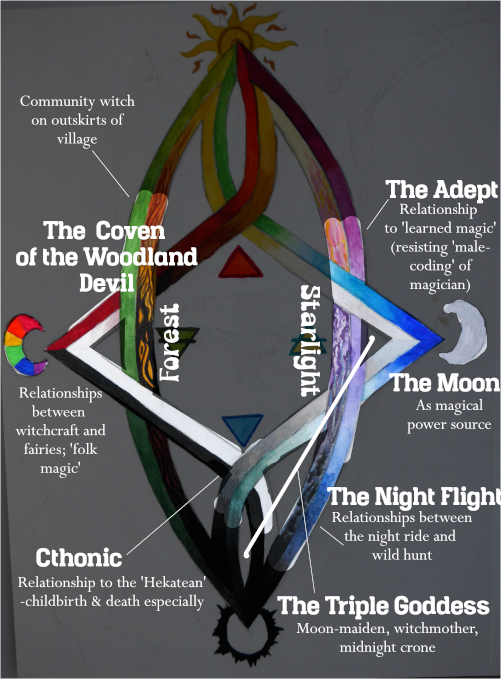
Diana is Lunar, and not associated with the weather, year, or land cycles - she is always present in her power, just as we witches do not wax and wane. Nontheless, standard Wiccan insights about the qualities of different moons work fine.
Is she a fairy? could be. Is she of the dead? also likely - all these are Lunar things. But she is not, initially at least, a 'goddess', but very much a personable entity - if farbeyond she is a mask for the ancient and otherworldly, it is hard to see.
Purple is just a witchy colour, isn't it? In my daily life, I am always looking at the barren mountains and, the big desaturated sky, a worldpalette of greys.Nontheless, it has some justifications on the map. I can see the Skyish meeting place between red fire and blue water, and I can also see the line across the map from blood-berry-red to the blue night sky, and I can see the shock of purple lighting as energy that sears from the sky, and the shades of indigo dreaming. And it is a little unnatural (magenta cannot be seen, it can only be estimated by the interplay of blue and red cones).
As well as a certain greyish blue the sky turns at night, when the details on the mountain are dark and too blurred to make out.
Appearance
For all that this seems so obvious, I think finding pictures is going to prove impossibly hard. I do have a folder of imagery, but far less than other spirits, they never quite seem right. I tend to get 'classy' more than 'scruffy'; and a smudge, like dark smoke passing by; and encounter her as a mature, non-nosense woman, self-assured and strong.
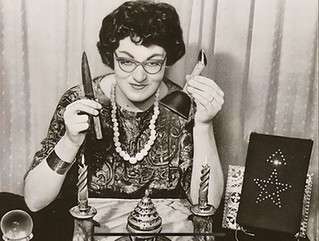
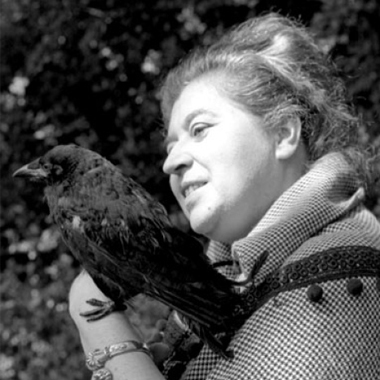
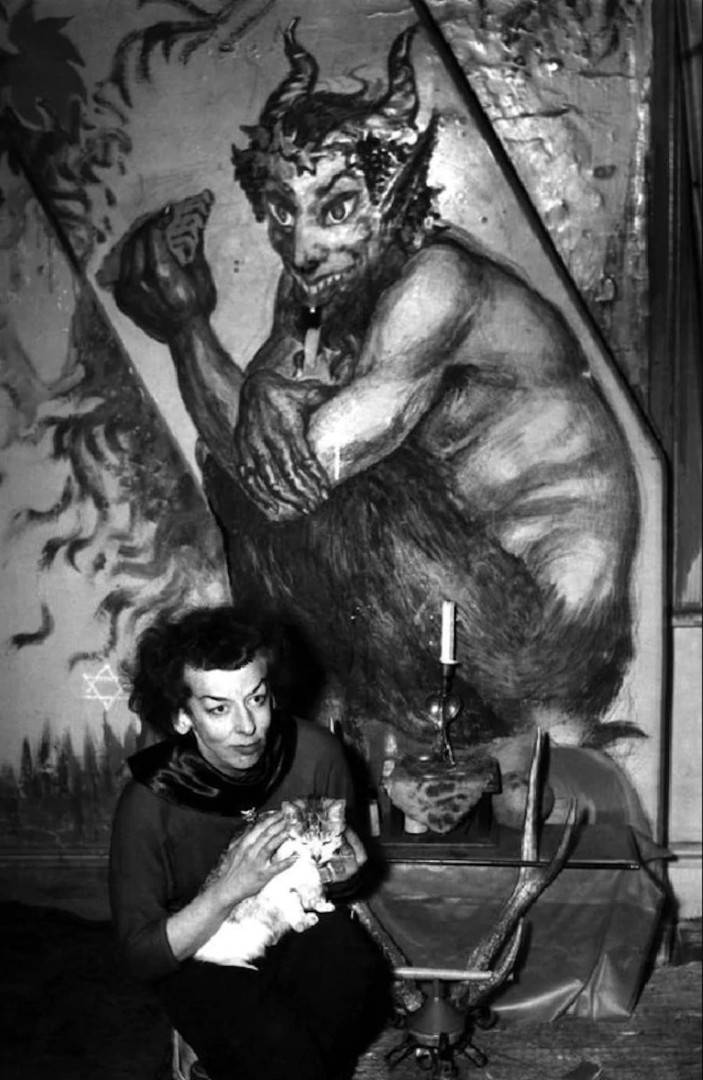
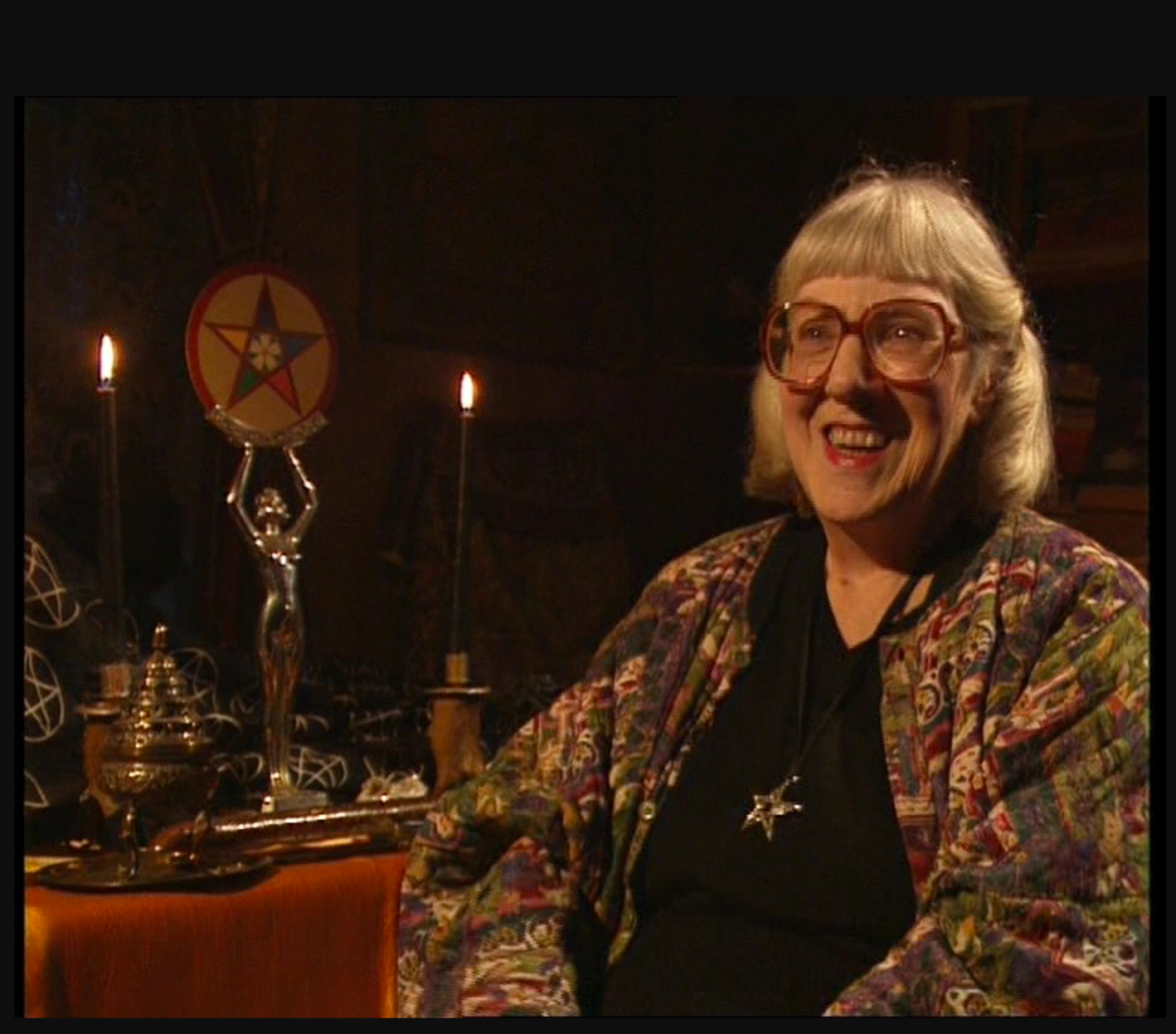
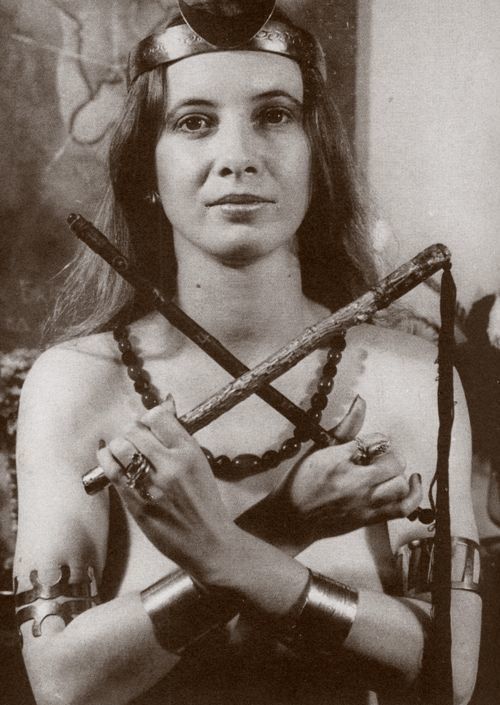
Hey though, have some pictures of vintage british witches. Love the everyday glamour and the way these women smile so politely and yet so clearly have a secret.
Tides and Times
As a Lunar spirit, she doesn't have times of the year when she is absent or present, strong or weak. She is outside those cycles, changing but never diminished - and the same is true across the month.
I tend not to assign her an annual festival, but I do a little something either on the Full or Dark moon depending on my schedule.
Symbols
You don't really need me to do this bit. Owls and cats and brooms and all. Occult iconography. Candles, books and bats. The chough.
Reading
You're probably best off searching around Traditional Witchcraft for some reading lists.
I have to say, in this strand I've read very few of these texts. My focus has been on reading less and doing more - where traditional witchcraft is concerned, I consider that I've got the spirit and time spent under the moon is more important than getting the details right. Because it's so phantasmagoric - and because, too, I'm a little queasy about using torture manuscripts - and because traditional witches tend to go for allusive poetry over providing tidy ritual recipes - I've preferred to go with what I know. The basic components - dancing for the devil at the sabbat; flying by broom; doing magic spells the way a child does magic spells - need little more than the image and then actually practicing, going there and listening.
And for all the words I've put down here, it need not be this complicated - this taxonomic noodling pleases me, like pre-exercise stretches for the occultist, they give my thoughts something to do at every moment of each day to keep the infinite in mind, and some of it takes me some place and most does not.
You don't need this many words to know the Witches Queen: she is already well-known. Just take up your broomstick and cauldron, and call.
Reading List
- The Witches Sabbath - Kelden
- The Witch; Triumph of the Moon - Roland Hutton
- The God of the Witches (1960) - Margaret Murray
- The Witch Cult in Western Europe (1921) - Margaret Murray
- the poems of Doreen Valiente
- The Rebirth of Witchcraft (1989) - Doreen Valiente, and everything else she's put in print
- Anything by Gemma Gary
- Nigel Pearson, Nigel Jackson, Nigel Pennick - apparently, a great name for folk craft Nigel is.
- Aradia: Gospel of the Witches - Charles G. Leland
- An Introduction to Traditional Witchcraft - Sarah Anne Lawless - with LOTS of recommended texts
And some media. For all that 'real wiccans aren't like witches in films, I have an immense fondness for witch fiction in all its forms, and have a section of the Reading List just for documenting them. They feed my imagination. Some especial choices for the Witch Queen as a figure include:
- Merlin (1998) - Queen Mab, technically a fairy, but she is marvellous
- Power of the Witch (1971) - documentary
- West Country Tales: the Poacher - arguably not related at all but look, look, I will never not be recommending this, it's a must see. I will take any excuse no matter how tenuous.