the Sun King
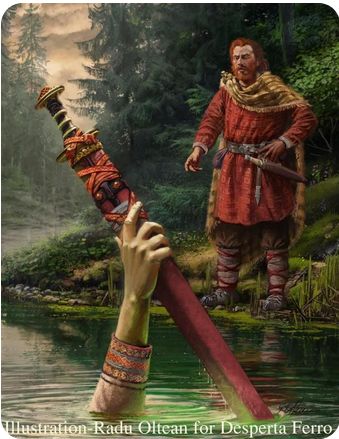
-Why have you done this to me?
-Because you were born to be king.
-What does it mean to be king?
-You will be the land,
and the land will be you.
If you fail, the land will perish.
As you thrive, the land will blossom.
-Why?
-Because you are king.
-No!
King Under The Sun
The Sun King is implied in most Solar practices. He is the embodiment of all things Solar: peace, fellowship, food, longevity, stability, home. He is not the Sun itself, however (for example, he is not Helios or Apollo).
So his title may more properly be “King Under The Sun”. You may think of him as “the necessary conditions which produce the Solar”. And this itself is a very Solar way of being: “if you want potatoes, you have to plant the potatoes when the potatoes need planting”; all the way up to, “if you want a just society, you must be prepared to build it and defend it”.
He is the things that happen when the sun shines. He is, perhaps, the symbolic representation of photosynthesis – the magic of the sun causing things to grow. Not himself the Sun (☉☽︎) or the Green (☉🞱), but their union.
By the choices the King makes, so will it determine whether and what kind of Solar reaches the people.
Why a King?
Landcraft is a correspondence system designed to catch and describe the waypoints and paths in fantasy and folklore. Central to that is the presence of the King.
In our lore, for historical reasons, this figure is usually a literal King – Arthur, Good King Richard, Aragorn. A very good example of why is Game of Thrones: regime change, invasion, the unexpected death of a monarch brought forced conscription, higher taxes, violence and plundering from everyone’s army, uncertainty. Similarly, the fear of a bad King – exemplified in Robin Hood by Bad King John and the Sherrif of Nottingham. The King embodies the prosperity, stability and peace in the land – mostly, through the (perhaps comforting illusion) of permanence, continuity and tradition he represents.
As for King Arthur, my touchpoint for this is Excalibur, which mixes him in with the Fisher King legends. Boorman has a symbolic style of filmmaking – as if he had just stopped looking at a tarot deck. He depicts life of a mortal man, the seasons of the year, the hours in the day all bound up in one cycle-of-the-sun, and on top of it, the figure of Arthur the King whose rising and falling is the prosperity of the land. Like many parts of Fencraft, this was an inspiration for me from a time I was very young, unavoidably embedded in my psyche of the sacred.
I was not born to live a man’s life,
but to be the stuff of future memory.
The fellowship was a brief beginning,
a fair time that cannot be forgotten;
and because it will not be forgotten,
that fair time may come again. Now
once more I must ride with my knights
to defend what was, and the dream of
what could be.
Law, Community, Civilisation

The King’s mythic role is “establisher, and maintaner, of civilisation” – with “civilisation” defined however you like. Sometimes I see him as the leader of a nomadic tribe, or the builder of a little wooden encampment of roundhuts, or sitting in a cut-stone town hall. Whatever coming together of human community you can imagine, he is its central hub, its point of balance between disasters.
In our myths, his courting and marriage to the Landmother – mighty goddess of the clouds and rain – permitted humanity to begin reliable agriculture. He is also called “tamer of horses”, with the horse presumably symbolising the forces of nature being shaped to support human flourishing. He is usually depicted surrounded by retainers and companions, showing him brokering deals between rivals, building compromise and alliances, using his powers of law and peace to construct communities, as well as establishment/institutional forces built to endure. He is finally associated with the wall and the shield, the necessary defences to protect whatever has been built, and make it permanent.
The King represents our link to the ancestors – to what we might call the Solar-Of-Man, as opposed to the Solar-of-Nature implied by the Sun more generally. The Solar-of-Nature concerns the cycles of the land and nature, our necessary work to plant in the spring to harvest in the autumn, our necessary wisdom to know when comes the rain and the suns. The King’s energy is related to maintaining that cycle for man, in that classic patriarchal sense of a Head God, a King, and a Paterfamilias all blurring into a single identitication.
We abstract that out into energies related to the family, to social roles (mother, teacher, fletcher), to life events (marriage, births, deaths) and the necessary rites accompanying them. Governing the mortal world and its rhythms is his duty.
The power of enclosing land and owning property was brought into the creation by your ancestors by the sword; which first did murder their fellow creatures, men, and after plunder or steal away their land, and left this land successively to you, their children. And therefore, though you did not kill or thieve, yet you hold that cursed thing in your hand by the power of the sword; and so you justify the wicked deeds of your fathers, and that sin of your fathers shall be visited upon the head of you and your children to the third and fourth generation, and longer too, till your bloody and thieving power be rooted out of the land.
Winstanley
Stability
The Sun King is “old ways are the best ways”, and the power of tradition and stasis. Where other Powers may resist, he would consult the law and put faith in institutions – avoiding change if at all possible. The King defends a worldview in which change and novelty is always dangerous – because the source of his power as a Solar creature is in repeated Right Action. If everyone knows their place, performs their role, the spirits are placated at the right time, the crops are planted at the right time, then the world will not fall out of joint.
So the Sun King also embodies stagnation, as well as the strength of tradition; and tradition’s oppressive and constraining nature; and the problems that come with lack of flexibility, innovation or motion. It is to be trapped by convention in a place one cannot get out of (be that a social role or a small village). We often see the King himself as a trapped sort of figure, bound to a constrained set of duties; and when the King steps outside of it, it normally denotes a “failure” (for the King is no longer what the King must be) bringing hardship to those relying on him.
War
“He was glad that he could not see the dead face. He wondered what the men’s name was and where he came from; and if he was really evil of heart, or what lies or threats had led him on the long march from his home; and if he would rather have stayed there in peace.”
The King is “if you would have peace, prepare for war”; and he is “I love not the sword for its sharpness nor the arrow for its swiftness; I love only that which they defend”. He is not a warrior by nature, but by necessity. He rides a horse and bears arms, but his primary emblem is the shield. The Sun King does not oppose all war (that characteristic might be given to the Wanderer), but does his duty at times of need; only dark aspected and failed Kings seek war for its own sake.
A key Sun King theme is the pity of what happens to ordinary villages in such times. It is common in Roman pastoral poetry to contrast peaceful shepherds and farmers on their land, with those same farms and hillsides ruined by war and the men pressed into service far from home. The Sun King’s power (and responsibility) is to prevent this from happening.
As well as war with other mortals, the Sun King is mundane and parochial: his walls also keep out the darkness, the unknown, the untamedness of the natural world, and the strangeness.
It’s very telling about our culture, I think, that when one searches for likely images of kings, it’s almost impossible to find those in which he is not also a warrior. Note that Arthur is given a sword, and Aragorn’s is broken; Sam borrows a sword, temporarily, and has none of his own.
(Where is War normally placed on the map? I go back and forth, but the nature of Landcraft is for things to be encountered in different places to express their different aspects. In one sense, war is archetypally Solar: we are the only people who do it. But typically the glory of War, its joy, its outward-facing and active aspect tips Sol-Lun under the Light and Fire, as it is a motion outwards from the stagnant village; its chaos and engulfing horror down through the Lunar-Stellar, and of course its long memory is the Landweird, haunted fields and absences. In short, however, a Sun King who goes on an aggressive war is outside-of-his-purpose and on a course to damnation, doubly so as the Solar embodiment of what has always been for whom change and novelty is especially tabooed.)
Forth rode the king, fear behind him,
Fate before him. Fealty kept he;
Oaths he had taken, all fulfilled them.
The Role of the King
When I think of the Sun King, I think of the phrase “benevolent feudalism”: a utopia where everyone has found their comfortable place, and there is no more striving or competing or suffering; where everyone works according to their skill and rests according to their needs, and is happy. A King is born to be a King, and is good at it and happy to be so; a Peasant is born to be a Peasant, and is good at it and happy to be so; everyone has their place in the great wheel under heaven. We watch a lot of Chinese movies at our house, and I think I am additionally influenced by Confucianism here - the interlocking clock-cogs of court. If the Lunar is the Dominance of the Self, and the Stellar is “natural and supernatural forces greater than oneself” – then perhaps the Sun, is “mortal systems which are larger than oneself”, and our own powerlessness before it.
This vision of Kingship underpins much of our fantasy lore; such hierarchical systems in reality are rarely just or bring abundance. Still, this is why he is the perfect King: the imagined version of a King, who we compare our actual leaders to. In your own life, and perhaps in your spiritual imagination, Sun Kings will not always be literal monarchs – but that heartspoke of community by which its blessings are maintained.
The Sun King is a placeholder for our ideas about society, never their endorsement – after all, there are 5 other points on the map that are not-king, 5 alternate ways of being, 5 challenges to that value system.
Paradoxically, the King can be one of the hardest figures to get our heads around. It is important to try and look through what the King later became. He is the ordered world against which the other figures are set; but this is not innately wrong. He is the god of the home, the hearth and the family, the nurturing protective figure, provider of food. Unjust law and use of state power is an inversion of what he represents – his dark aspect. Try and discover a Sun King figure which meets your needs. It is good to be at peace.

One really important thing to be alert to is, as modern pagans, our attraction to spirits of dark and chaos and instability. Our life has a certainty theirs did not, and so contemporary pagan practice often looks wildly different to ancient practice: our religious lives express a craving for sensation.
Is this important? Not necessarily: our goal is not wholly to mimic the past. And yet it is strange, when our forebears saw Demeter of the grain and Thor of the farmer as their most beloved gods, and here we are with more Loki disciples than, surely, there was at any point in history. It communicates a kind of luxury and confidence in our basic access to food, and our likely freedom from war, that we do not revere the spirits of sustenance and stability any more. And there is a level on which I see that as a problem.
The Map is a map of many things, among them spiritual practice. You may locate on it different relationships to the divine, different theories of man’s place in the universe, different expectations of how the divine will behave towards you, and so forth. The Solar position embodies your peace, stability and nourishment, as much as it represents anything, and part of our task is to NOT see it as boring. At the same time, it comes to represent a standing-still, traditionalism establishment one must reject to step outside the village and onto other paths. Try and let it be both.
I must additionally add, that the King is you. As core, we try and see the Powers of Fencraft as independent in their own right – instead of aspects of the self, but we also use devotional and channeling techniques to fill ourselves with the divine and walk as if we were in their story. I am influenced here by Ross Nichols’ “go into the barrow and take the sword, for it is always your sword”, as well as Viggo Mortensen and Nigel Terry’s humble and humane performances as Aragorn and Arthur respectively, finding the appeal in roles that could have been made arrogant or stiff. Within your own life, you were once young, and grew (or are still growing) into maturity, wisdom, responsibility and power; and so the King’s path is also your path, at times.
The Fall
It is the nature of the Sun to set, for men to die, and Kings to fail. It is the tragedy of the Sun King that peace cannot be eternal, and that he himself is fallible. He is, after all, somewhat like the sun. In the next essay, we’ll explore his aspects and his cycle.