Sun King Cycles
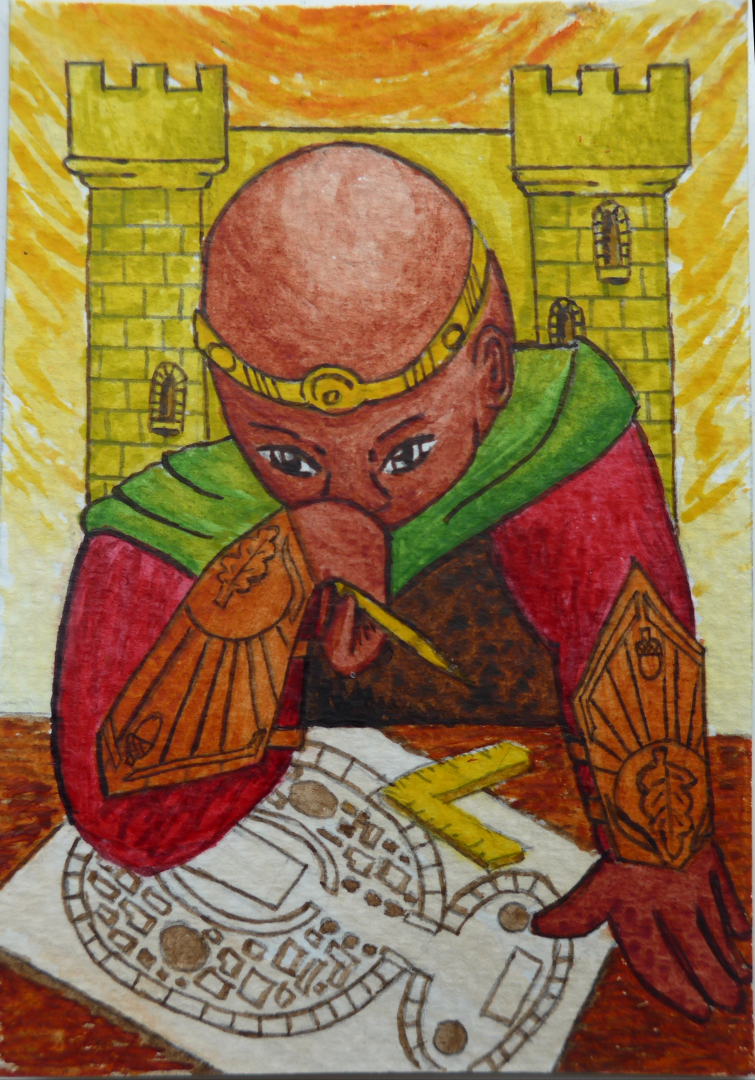
“A king should be afraid, always. The enemy is everywhere. Waiting in ambush in the dark corridors of his castle, on the deer paths of his forest, or in the gray and winding paths of a more tangled forest, in here – in the mind.”
The Sun King’s rise and fall is closely related to that of the sun, across the day and the year, and is thus one of the easiest spirits in the system to track.
Bound To Duty
The king is trapped inside his cycle; he has no insight outside of it, and cannot act otherwise
- Bound to time – he is mortal – he will be born and he will die
- Bound to a role – he is born to be king, and this role defines him; he is bound to it, and its duties
- Bound to his promises – to repay his loyal retainers, to alliances with other kings, to his pact with the Landmother
- Bound to the land – by his wellbeing and decisions will the land flourish or fail
- Bound to the cycles of the world – he has limited insight beyond the mortal frame. He is profoundly “unmagical”, be that in the elven sense of having greater Insight and Grace, or in the witches sense of knowing how to cast spells, or in the Stellar sense of being a mystic with a sense of presences in the land.
And yet, the king has a certain kind of magic all of its own, related to the sacredness of Right Action. The king cannot cast spells on a whim, but his presence is a spell – a spell of the land – so long as he correctly performs and embodies his sacred role. The king therefore embodies the pressure of personal responsibility, and sacrifice on behalf of the greater good. As he is just, so the land will be just; as he is dissolute, so the people will suffer.
The King’s attempts to step out of those cycles are always disastrous. For example, his attempts to become magical become warped and sorcerous. His attempts to live forever become undying and greedy. Attempts to take more than his share become decadent and cruel. His attempts to progress become the wasteland of cruel industry, and his attempts to move and campaign become war without end. So there is a kind of tragedy to the King, in that he embodies duty above and all, and self-sacrifice and self-restraint – an awareness of himself as part of a community, and that community’s needs must come above his own. That is the lesson that the King has for us.
It’s good to note at this stage that these cycles tend to occur in any “mortal man” within the system, and so to some extent describe the Lightbringer in one direction and the Hunter in the other.
I was not born to live a man’s life,
but to be the stuff of future memory.
The fellowship was a brief beginning,
a fair time that cannot be forgotten;
and because it will not be forgotten,
that fair time may come again. Now
once more I must ride with my knights
to defend what was, and the dream of
what could be.
The Day Cycle
Firstly: the King is not exactly the apexes ofthe day; I think in part, because he isn’t the sun, and in part because his influence is slow – he is tides not points, he is not intensity. So, the four apex points of the day are more often given to the Lightbringer.
Still, the King is roughly fourfold. In the morning, he is a young man – wide-eyed, confident, questioning, experimenting. In the afternoon, he is a mature man, his kingdom and harvest established and enjoyed in peace. In the evening is his fall, into blood and corruption, or old age and senility. Overnight, he is absent: the Land without a King; and unearthly forces hold sway, unbound and unmastered. And the same is true across the year
He is not notably different between these four points, they follow a fairly intuitive pattern of his attributes rising, flourishing, the slow coming to the fore of their decayed and flawed aspects, and the nightmare of their absence.
Colors
His colours:
- In the morning, the young king is dominated by greens, often of a slightly blue-r character, or green with white
- In his flourishing, the Sun King is greens and yellows and yellow greens and warm reds, as in my painting
- In his fading, if the manner of his fading is by senility and age then the colours are white and brown.
- But if it is by lust and greed, domination and exploitation, then the colours are blood-red and deep black
- In his absence, black predominates, or blue/cold colours – look to the lack of his gold under-colour

Aspects
The King is defined by duty, the limits of the role he was born for, the routines and traditions he embodies and thus must repeat. In that sense, any aspected king is therefore a “bad king” – one who has stepped out of the rightness of his set-down, long established rhythm. In practice, however, these aspects different kinds of King; or different kinds of mortal, or different kinds of slightly-fallen responses to the call of the sun.
And of course, good kings need a little of all of this.
By the moon: the Philosopher King
His strength is drawn more explicitly from the wisdom of old books, from cleverness and thought, with more lunar qualities of quietness and reflection. Not necessarily a bad king. However, his flaws are to become isolated, paranoid, sometimes sorcerous. Denethor might be a template.
By the Solar-Lunar Light: the Warrior King
The Solar-Lunar Light is generally a challenge to the King, not the King himself, and its colours are red and bright gold and black. As a tendency for the king, this point represents too much human fallibility in one place: ambition, change, building, industry, campaigning wars for their own sake, greed for gold. This King can, it is true, often be incredibly charismatic and loved by his followers, but ultimately too much of this is the King out of joint. Uther is one example. The blood red setting sun, and the black-and-red fires of industrial machines, could be said to be its inversions.

Double Solar
Too much of mundanity here: the everyday powers of Just Some Bloke. The King does have a sacred role – he is more than just a man; more than just time spent with his retainers and at the feast, and so he needs at least some greater awareness. I think of Boromir here: practical, and mundane to his core. Not a bad person, but no insight into the beyond, nothing but a man.
By the Star
The colors are a tint of gold mixed in with black, producing a sort of muddy sandstone, contrasted with the vividness of black, and may be described as institutionalism run amock – rather like being trapped in Gormenghast. Meaningless ritual, cruel and arcane law, being boxed in to the city where nothing grows; the King himself has become the system; the dryness of dead paper in books, everything regulated, everything orthodox, perhaps the domination of a Church or the Law or some other faceless abstraction. These are the King’s attributes, devoid of their devoid of their humanity.
As a landscape, this is referred to as The City - a place of brass and stone.
A second meaning of this position is the ancestors. The king mediates with the dusty dead in appropriate ways. The Stellar here refers to memory and the hauntedness of the land which, in a limited way, comes into the Solar world when we think about the dead. Think of a worried king wandering the paintings of his forebears asking for help stone lips will not speak. This position is not bad, but it intensifies Solar qualities of stagnation, tradition-bound and patriarchy.
By the Solar-Stellar: the Hunter King
So where I’m at with the Hunter is still up in the air, but there is a sense of something here.
In this position, a mortal man goes in and out of the natural world, using the King's power of mediation to keep human and animal worlds in balance with one another. The king's success or failure influences the abundance of the natural earth. The core king might make treaties with mortal barons to make peace and laws so fields can be safely maintained, but this king must speak to the soil itself and by doing Right Action blight will stay away.
There's some overlap between this figure and the Guardian of the Green, so differentiate the by remembering that the King is ultimately a man who is asking nicely - whose sacred role is to do the right ritual and ensure the right agricultural techniques and supporting human culture that growth is possible. He does not have the magic of the verdance inherent within him.
Suddenly Tom’s talks left the woods and went leaping up the young stream, over bubbling waterfalls, over pebbles and worn rocks, and among small flowers in the close grass and wet crannies, wandering at last up on to the Downs. They heard of the Great Barrows, and the green mounds, and the stone-rings upon the hills and in the hollows among the hills. Sheep were bleating in flocks. Green walls and white walls rose. There were fortresses on the heights. Kings of little kingdoms fought together, and the young Sun shone like fire on the red metal of their new and greedy swords. There was vicory and defeat, and towers fell, fortresses were burned and flames went up into the sky. Gold was piled on the biers of dead kings and queens; and mounds covered them, and the stone doors were shut; and grass grew over all. Sheep walked for a whie biting the grass, but soon the hills were empty again. Barrow-wights walked in the hollow places wth a clink of rings on cold fingers, and gold chains in the wind. Stone rings grinned out of the ground like broken teeth in the moonlight”
The Year
The Sun King parallels rather closely many of the aspects of the Wiccan God, at least in the agricultural sense. He is born and dies with each year, being related particularly to the grain, and the cycle of summer/winter. In Fencraft, spring/autumn is given to the Changeling.
Parts of the Sun King’s ritual cycle are currently unknown to me, due to my blindness to the Young King/Hunter who is present but veiled to me. But certainly, he is a young man in the springtime, and so forth.
The Wooing of the Landmother
Around March & April, we celebrate the sequence of him seeking for the Landmother, the ruler of the skies and clouds, that she might roll them back and permit the suns and rains for the crops to grow. This is the Sun King’s first myth: and it is notionally a romantic one or possibly, a more neutral alliance-making, or a more sinister story of kidnap. In any case, this time of the year that is a fight between summer and winter weather, is a time we give to spurring him on & pleading her mercy. Its colours are green and blue and white, and watery-white greens.
It is probable that their marriage is around May Day, although this is not its primary association.
His Coronation
I do not currently have a set date for this, but the period of the summer is broadly his and is the world under his rulership.
Lammas
The Sun King is the John Barleycorn, who is slaughtered so that the wheat may be gathered, his bargain with the Landmother fulfilled. Its colours (as you may see on the map), are gold and the grey of a brooding sky.

The Winter King
From this point until the spiringtime, we are in the Land Without A King – where his order no longer holds sway, and restrains the dark and wild forces of the world. However, at September 1st the Winter King rides into the cycle, an autumnal figure who in some way represents the King-in-Winter, for when those energies are needed in the long dark. Never the most powerful, but resilient and enduring, he has his own page. He is generally understood as the Sun King’s brother, as well as his winter’s echo.
The Winter King is sufficiently large of an aspect as to have gained his own page, here.
