Solar-to-Lunar
Spirits from folklore are quite overwhelmingly discovered on the Solar-Lunar path, because humans tend to seek powers with relevance to their lives -
This is a very broad and initial list of the sorts of spirits who could be approached as part of this frequency. Each of these figures have some aspects which characterise the Solar-Lunar. In all these examples, think of the characteristics of Solar and Lunar that you know, and consider how they express their tension or blending.
The Lightbringer
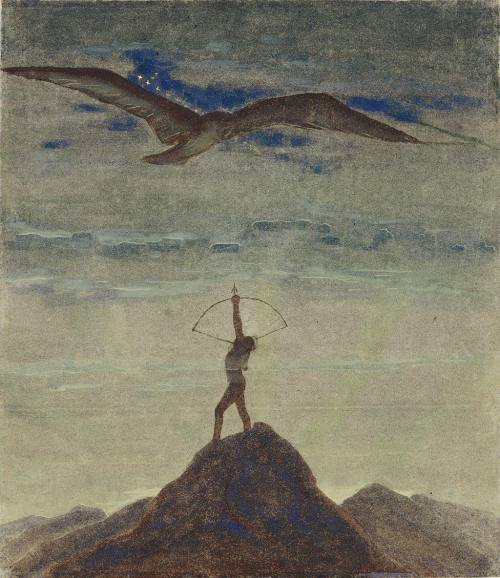
The Lightbringer is the Fencraft spirit who most embodies this Path, a kind of Lucifer-Prometheus figure. In him, he unites the themes of trickster, warrior, rebel, outsider, thinker, craftsman, dissident, explorer and the light of sun and stars.
Learn more:
- The Lightbringer (Images | Commonplace)
Tricksters
the Devil, Loki, El-ahrairah, Sinann
Those both inside-and-outside the community. Loki invited to the feast of the gods but causing havoc by speaking what ought not to be spoken.
The Warrior
Ares, St Michael, Gandalf, Mithras, Lugh, Thor, Hermod, Tyr | Saxnot | Tiw | Tiwaz, Surtr
Mortal but with an outward-facing energy, such as the war-leader who expands aggressively and seeks conflict (contrast to the Solar King, who fights only in defense and makes pacts with others around him) - expressing ambition, greed, restlessness, outside of the stagnant Solar sphere.
In history, it seems that the idea of a
Therefore more true to say the SolLun is Warrior fragaments and aspects as often as it is whole spirits.
I've included an aspect of Gandalf here as an example of the Warrior image being more abstract - someone who comes as a protector and campaigner who is able to lay down a smiting, but not with a sword.
The Rebel, the Outlaw, Enemy of Power
Robin Hood, Mordred, Joan of Arc, Boudicca, Lucifer, Winstanley, Icarus, Prometheus
Cast out of the village and yet still obsessed with it - coming back into it and bringing change which cannot be imagined within it. A necessary renewer to the stagnation of the Solar, and thus most feared. You could see this as as a combination of Warrior+Trickster.
This figure is often an
More on Biblical themes
God, the Father, is associated with a Solar norm – and the Jesus who will return and bring Heaven with him is a Solar-Lunar dawn force. But the Heaven he brings is also Solar, a new form of stagnation. Hope always falls short, and always needs to be renewed. It’s one of those things that both Jesus and Lucifer occupy this space on the Map; because Lucifer is also a son who will bring renewal, of a different kind, to the current order. Their imagery is markedly similar, of light coming out of the darkness. A third Christian figure occupying this spot is St Michael (who often appears in Western Ceremonial magic; I'm told by a relative that in their Christian sect, St Michael IS Jesus in another form). This may seem strange, but there’s a unified experience of YES that all three divinities evoke, an explosion of hope and glory.
Gods of the forge and of craft and cunning
Brigid, Weyland | Volund | Egil, Ogmios, Aulë Craeftfrea, Melkor and their Maia (Saruman and Sauron), Goibniu, Creidne Cérd, Bragi
Relevant to human life and society, but a little set apart by their
Scientists, Thinkers, Etc
Great men of science who changed the world by discovering something previously unknown and very uncomfortable, but particularly Galileo as a kind of Lucifer figure. In fiction, Professor Quatermass and the Doctor - scientific curiosity underpinned by a strong ethical drive; outsiders, disrupters, travellers.
the Sun and the Light
Helios, Phaethon, Earendel (dared the Valar; travelled; morning star), Elbereth, Dag and Skinfaxi
In Fencraft, this point is most associated with gods of the literal sun and light sources. Yes, I know. The Solar point is not, in fact, the most sunny one. I’m sorry. It irritates me too, but at the same time is in part its purpose to split out these ideas like The Sun into smaller parts, where here the Sun is the brilliance of a celestial body, but on the Solar it is the impact of the sun on the land.
In Ceremonial Magic, the notion of Enlightenment or holy light; Hermes; in Thelema, the sun as renewal includes Horus, who defeats the darkness. If you wanted to do a Tree of Life/Ceremonial adaptation, it’s probably where you’d place Kether; in a Christian adaptation, this is probably where you’d place white light of spirit and so on.
And also
St Thomas, Skírnir, Hermes (magician, traveller and trader aspects), Gnu (Frigg's handmaiden)
Some Aspects
The First Initiator
When we step out of the village, and especially when we do so intentionally as a witch seeking wisdom, we are looking for that first figure to lead us into adventure and reveal to use the mysteries.
This moment is noted in story theory: In Wizard of Earthsea, young Ged meets the older wizard Ogion; in The Weirdstone of Brisengamen the children meet X; in The Lion, The Witch and The Wardrobe, Lucy meets Mr Tumnus. And so forth.
This figure is both ☉ and ☽ - someone who is magical in nature or has magical skill, who is a friend and protector.
This is an aspect because this figure can appear in any guise, depending on the direction you go. The classic figure is some kind of wizard, but it could just as easily be a Guardian of the Green if you are to learn the secrets of the woodland, or some kind of god of the witches if you are to learn the art. Sometimes these figures can appear by surprise, and no matter how far you advance on one journey, you might always meet an initiator who will lead you in quite another direction.
The most important figure in Fencraft related to this aspect is the Keeper - a person which leads us into an understanding of the Landweird.
The Fading King
This path rules variants on the king who are, in some way, flawed. Too priestly, too wizardly, too wandering, too winterbound, too warriorlike. For the King, this path is dangerous instability.
All things must be as they are, and this is especially true for kings, as the Solar is so much about tradition, duty and repetition of old patterns: no amount of novelty is good for a king.
Spirit in Man
These myths often concern the divine taking physical form in man. The Solar-Lunar is extremely “celestial” in character, while at the same time being the most humanocentric of the frequencies. How can we resolve this? Influential myths for this point include Penda’s Fen, Robin of Sherwood and the New Testament, all of which show something divine becoming flesh in the body of a person, so that they can be used as a kind of weapon, or as the embodiment of a Solar-Lunar will to change.
Even when this does not literally occur, it remains implicit in the sheer arrogance of this frequency. We see Icarus and Prometheus aspiring to what only the gods can have, and Galileo defying the will of the church and declaring his knowledge all-powerful.
As the least-wild, least-cthonic spot on the map, it is here we can declare that gods do not frighten us.
Isn't the Solar the least wild, least cthonic?
Think of it this way: the Solar is the absolute mundane, but it is also the passive submission to what is, be that the structure of society or the will of a greater God. In its own way, that can be quite spiritual, quite alive to the way of things. The Solar Lunar adds that touch of lunar brilliance to a mortal mind which brings with it overconfidence. The Solar shuts out the wild strange by staying at home and not thinking about it. The Solar Lunar shuts it out by walking right up to its door and knocking. The Solar Lunar makes you discount wildness and the strange as things that can be explained away or overcome. The Solar centers everything about the human world, but as the touch of Lunar adds this note of the individual, the Solar Lunar is more about human capability as this abstract force. The Solar Lunar brings us into contact with fairies, spirits and otherworld creatures, in the Solar Lunar phase these are encounters that generally can be handled through intelligence, boldness, craft and hubris. As we travel further down the map, this becomes less viable.
Similar, here is the concept of to be
Some Roles
As well as named gods and spirits, there are archetypes of people and practice associated with the Solar-Lunar. These are roles you may inhabit or step into. They are also aspects a spirit may be encountered in.
The Local Wizard, the Priest, the Fairy Doctor
People who connect the human world to the other world, but in a near-Solar kind of way - they are more of the everyday than the strange. The Wandering Wizard archetype is here (Gandalf comes and goes in mortal society. Note the other wizards, failing - Radagast is too Lunar, Allator and Pallando too Stellar, Saruman too Solar. To be a wizard for the god of rules is to walk in balance).
Any time Gandalf channels the higher powers (to smite the Witch King, bring the relief riders at the battle of Helms Deep, to take on the Balrog. The latter scene is an interesting one, because the Balrog is also elementally in a similar place - stone and fire, but stellar dark - and Gandalf is fire and light and solar-lunar, who has seen the heavenly light of Valinor but is wandering between the hillsides to minister to man.)the Seafarer, the Wanderer
Explorers - mortals who travel outwards from their home, often embodying ambition; and those without a home, who wander aimlessly from place to place, embodying doubt - the call to leave the village without the commitment or clearsight to step into the Lunar. So the symbols of horses, birds of prey who travel far and float on the winds near hills, ramblers, questing knights and people who go between human and fairy worlds.
Typically, the Wanderer is associated with the Hillside and a sense of aimless doubt and directionlessness, or with rambling in the hedgeways and highways around the Village but without the clarity to take the next step. He is Land & Air and lacks light and fire, and with it the ability to get anywhere. The Seafarer, by contrast, is a far more active and directed figure, and his horror is his willingness to go into the deep far strange.
Learn more:
- Figure: The Wanderer
- Place: The Hillside
The Ranger
Another Landishpath interpretation of this energy is akin to a mixture of Priest+Seafarer. On the Skyishpath, the Priest mediates between the people and the divine - the abstract forces influencing our lives. On the Landishpath, the Ranger travels between the vilage and the edges of the wildwood, mediating between the people and forces embodied within the physical world, as plants and beasts.
A Ranger is similar to the Seafarer as a mortal figure with the boldness to travel deep into the Stellar, but her destination tends to be different - towards a SolarStellar absorption and transformation instead of a LunarStellar annihilation
Learn more:
- Figure: Forest Fellows
Teachers, councillors
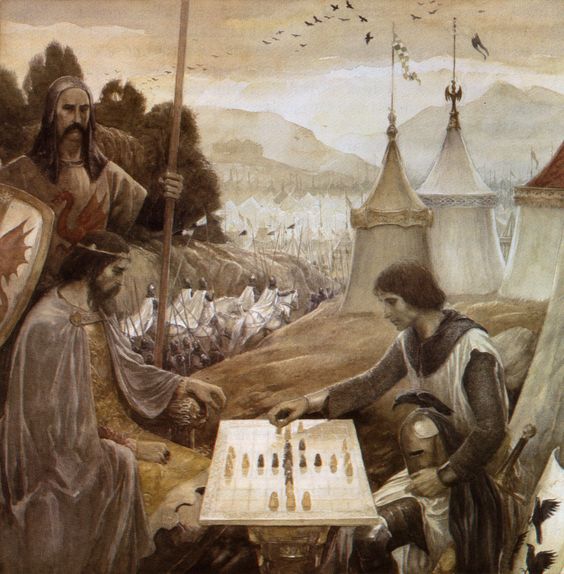
That sense of something from the near-outside touching the everyday, but for example, a demon that comes to a wizard as a teacher, a wizard that comes to a young king as a teacher, a goddess that comes to a mortal as a lover, a human and an otherworld mentor or patron god, a priestess with a particular devotion. Joining the Solar of the human everyday to the Lunar of non-human beings, but still under the aegis of the Solar where relationships are beneficial and safe to humans
People who are young or old
Joining the Solar of human lives to the Lunar of change, and in particular the image of a meeting between people across a generational gap.
Readings
Some relevant images to consider
- Stephen ascends the hill to think in Penda's Fen
- Mordred challenges Arthur for the throne in Excalibur
- Robin makes the prisoners believe that fighting back is possible in Robin of Sherwood: Robin Hood and the Sorceror
- Gwyn runs away up the mountain in The Owl Service
- Ged flees what he has done and wanders the sea in The Wizard of Earthsea
- Gandalf knocks on the door and tempts Bilbo to join an adventure in The Hobbit
- Aldarion would rather adventure by sea than rule the kingdom or come home to his wife in Unfinished Tales
- No. 6 fights for the right of the individual to be an individual in the cosy inescapable Village of The Prisoner
- Galileo is put on trial for challenging the state Church's view of the man-centric universe
- Earendel sets sail to defy the ban of the Valar in The Silmarillion