The Landmother Rules Over...
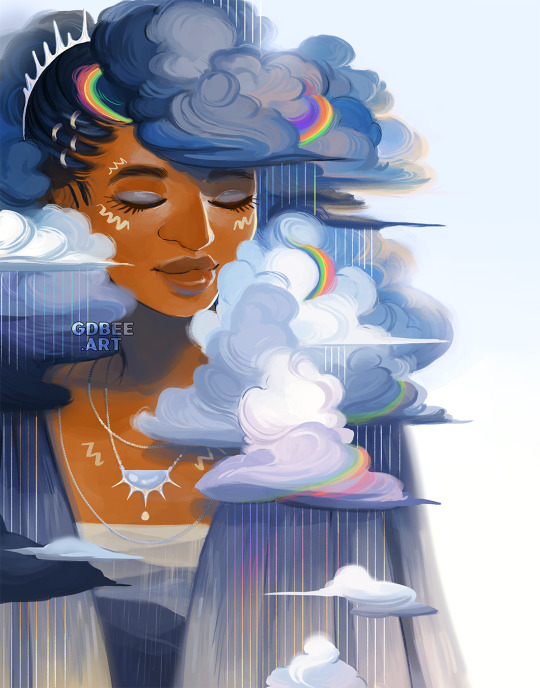
It can be hard to get a clear pin on what the Landmother rules – She is huge, and due to both Mary and the Goddess, tends to pull other spirits and goddesses into her cycle. This article is a sort of sketch outline of what She does – and importantly, does NOT rule. You’ll go a long way to learn about Her, I think, by meditating on the qualities of a miserable overcast day – its colours, weight and wetness.
A short list of things the Landmother is not the goddess of, and yet has some relationship with
If you are confused, stay focused on the ways that She is a spirit of Weather and the Sky – particularly:
- the presence or absence of clouds, to permit or deny the sun
- the presence or absence of storm, to protect or threaten fishermen
- the presence or absence of rain, bringing flood or drought
And here are some domains with which she is often confused or blurred:
Sunshine
There are many kinds of weather which are not Her; we could understand her as some kind of moderating influence upon the sky. Ones to be careful of include sunny and starry skies, the wind without storm or fog, pretty colourful clouds, and a heavy dry fog which is dry. These are generally not thought of as Landmother.
The Sea
She is a Sky divinity. But a storm upon the sea would be understood as Her influence, so perhaps this is a moot point – there is little more important to the seafarer than the will of the winds. Still – She is not a whale or an angler-fish. You can understand that in fisher communities, the Landmother’s role would experience considerable blurring with that of other sea spirits.
The Stars
Within the stars, we must be very careful, because the Landmother is again here a facilitator. That is, just as the Landmother of the weather rolls back the clouds that we may have sun on the fields, so Landmother of the Stars rolls them back that we may see the moonlight to travel by and the stars to guide us. In other words, though we celebrate her starlight, she cannot be fully said to be the stars; and in BTA the role of both the stars, the mystery of the dark, and of light itself is very important but associated with other spirits. Watch this space, as this is still something I’m thinking through. She is not the peace and beauty of the stars, or their reassurance, or their terror.
The night sky
In a Sun King/Landmother paragdim, then an understanding that he is the day and she the dark certainly works. But again, I’m not wholly certain of this just yet. A reading where he is the summer and She is the winter is a fit, but think of the night sky as a useful correspondence, rather than a thing She is ruler over.
Fate
There are two other spirits with much closer relationship/rulership over fate, who I’m still teasing out (more stars, more sea…). The Landmother is a guide to necessity, duty, complying with fate, to acceptance of hard truths, enforcing geas and is generally the symbolic representative of acting in accordance to taboo. I suppose Her relationship to fate may be seen as rather like Tolkien elves, people who have an insight into what must be, rather than people who have a knife on fate’s thread.
Death
Again, like Fate, there are other spirits who might be said to rule the dead, bring death, or control the gates of it; but it is possible the Landmother is associated with funerary rites, burial or grieving.
Food and Fertility
Much like the sun, this one. The benevolence of Her weather permits, or denies, the sun and the rain to allow crops to grow, and in her myth we are told she brought cattle from the underworld as well as the skills of beer-making. Still, her role in that is not as the food or the fertility – she’s a waymaker. There are other spirits with this as a primary role.
Inland water
Especially lakes and running streams, with these being characteristic places to go to meet with and honour her. There is an instinctive interaction in the rain cycle between the rain that falls and the running of streams to the sea. It is possible that, just as the Sun King is understood and defined as a cycle of the sun across the day or year, that the Landmother’s cycle could be understood as a mytholygisation the life-cycle of the rain. I have a sense that, once again, She is not precicely the goddess of springs or lakes, but of rain, and there is then an interplay of course between the rain and the water that runs.
But I experience her in the might of dark mountains - carved out by the relentless patience of thin pale streams.
Magic and witchcraft
These are sole-Lunar, whereas the Landmother is Lunar-Stellar. You can imagine that in the context of a fairy bride entering a mortal court, She would certainly have certain abilities that would set her apart; but she is not a Hekate- or Mercury- type, not a witch or a magician, not one who rules over Doing A Magic Spell. She would not be your first port-of-call if you wanted to Learn To Do Magic, although of course she has very particular themes where She may be the master of them.
Spirits who are not the Landmother
She is not to be confused with the following, who also appear as ladies in blue. Note that, at this stage, these are names I’m using informally for fragmentary bits, and at this stage I’m not sure if any of these figures will survive into the final pantheon, without merging into others (and, potentially, merging back into the Landmother). Part of the “purpose” of each of these names is, indeed, to say “well that’s NOT Landmother, where can I put this instead?”
- Estë-Nienna
- healing, tenderness, replenishment, often along with water and pools
- Elbereth-Lightbringer
- A spirit primarily of hope, light-in-the-darkness, of the light of the stars themselves at night time, rather than the sky or the darkness
- The Fisher of Souls
- The shoreline and the sea and their mysteries, rather than the weather upon the sea and its changeable nature; along with fate, birth and the dead
- The Queen of Heaven
- The stars and their mysteries, rather than the sky; along with prophecy, foresight, sleep and dreaming
- The Witch Queen
- The night flight, the sabbat, the crossroads, mysteries and witch religion, spells and covens, bats and cauldrons etc.
- The Winter Queen/Witch of Winter
- a parallel echo-myth to the Landmother myth, focused specifically on ice and snow. Generally seen as different to the Landmother, with more “witchlike” aspects – the parent of other Powers in BTA.

Womanhood
The Landmother is, arguably, the primary goddess in Fencraft’s pantheon; but she has no special relationship with women or the concept of womanhood.
There’s a real problem with the dominance that feminist-goddess-religion has in neoPagan thought (according to Hutton, this came from the USA in the 70s), and a temptation to make all goddesses who happen to be women into a Women’s Goddess. There’s a specific problem in this, when those trends within our faith become transmisogynist and trans-exclusionary; but also, I think, there’s an element of plain old misogyny to it as well, reduced to female reproductive functions, or not percieved in their fullness and complexity. “Police officers and female police officers, doctors and female doctors” but for the gods.
This then becomes a problem when our personal cultural ideas of what a man, a woman (or a something else) “should” be become an inner barrier to true perception. Taking something of a queer approach to it is, then, not merely a political agenda – but a spiritual tool, a way of seeing from the side; where, on the one hand, gender is symbolic and we can reflect on a specific women’s experience of political marriage and holding power in a union to a less powerful husband; but from another know that gender is not related to bodies – She is a thing of fogs and sea-foam, rage and inner control, necessity and duty.
In Fencraft, we generally encourage adherents to explore the Powers through other-gendered imagery (a Sun Queen and a Landfather, for example), as a way to transcend the limitations that humans put on a Power when they are put in a gendered box. I must confess, the genders in the Landmother myth generally seem quite “stable” to me – though they need not necessarily be so to you. Still, trying to envisage the Landmother as differently gendered is, I think, useful if you’re having difficulty seeing her as distinct from the Goddess.
I will write more on this in future, but in terms of the Landmother, the key takeaway is that she is not a goddess of women or related to women or womanhood or certain kinds of women or women’s experiences.
