The Winter Queen
The year's evil stepmother
In the Beginning
In my initial notes, I started writing about a mythology of the year that was overlapping. In standard Wicca, the seasons are mythologised by the interplay between one God and one Goddess. I felt something more polytheistic to be true, that the differing moods of the year were created by many separate, overlapping presences. Fencraft, therefore, has multiple ebb-and-flow tides going on at once.
And so, much of what I do now has a somewhat Wiccan flavour; but just separated out differently - something that could fit itself around Wiccan festivals for, say, participating in a local Pagan multifaith community, but with a distinct flavour that is more directly nature-based, and more centrally about the many little overlapping spirits of the land than a theistic mood.
In those early notes - how many different myths to explain the seasons' are there in the lore?
- one that stood out was a cycle of Brigid and the Calliach, summer and winter. As I've worked with this myth, Brigid has receded and what remained is a goddess of the weather and sky. Her double in the warm half of the year is the Landmother (typically associated, mind, with overcast days and fogs and rains - but weathers that can be mollified and a spirit who can be reasoned with, to roll back for summer days). Her double in the wintertime has remained far more unchanged: a spirit of the tides of winter, the snows, the cold, and the dark.
(It seems likely that the Landmother is also Calliach, great goddess of the British Isles, but experienced outside of winter)
Mythos
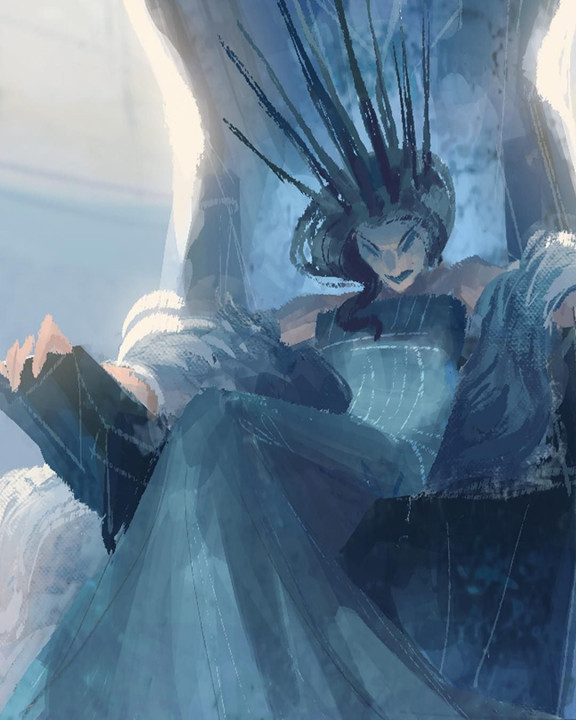
The Winter Witch has some interrelationship with the Landmother; understood as a sister, a rival, a lover, a winter aspect or a shadow self - whatever seems truest to you, because relationships between deities are not always straightforwardly indicating what they would for humans, but can be present as a shorthand for a ritual relationship, a mythic interconnection.
What is certain is that after the killing of the Sun King at Lammas, the Landmother is no longer present as a benevolent force who can be reasoned with and depended upon. She is monsoons of grief, or she retreats from the world of men back to the hidden places where her own kind dwells. What is left behind, is a power vaccum and a hungry populace.
Into this gap rides the King-in-Winter, our response to the theme of the Oak-and-Holly-Kings - a brother or a rival or a lover or a shadow self to the King of Summer, who is mortal and is shaped by the season into a figure more sober, more calculating, more reserved, and driven by the need to keep his people behind the walls of a hibernating hall, to hunker down and survive
It is towards this paranoid, haggard, resolute court that the Snow Queen's sleigh approaches (drawn perhaps by wolves, or polar bears, or cats; something quite unnatural-of-the-wild about all this). Perhaps the Winter King determines that he too needs a fairy bride who can once again renew the land - as the Summer King did - or perhaps she arrives of her own accord, sensing blood.
But, her intention is not to play second fiddle to the Winter King, nor be a mere consort; and winter is her home and her delight. Think "always winter, never Christmas" of the Narnia books; think Morgana-Nimue draining Merlin of his skills and strength before entombing him in a tree. Man's greatest fear of winter is always that it will be unending.
As the months progress, the Winter King is drained to a husk, a shadow, the year in its dotage - his promise, unfulfilled. I associate this part of the tale with the period after Christmas, coming up through January and February, where despite the return of the sun the weather gets grimmer by far - as if the only check on winter's power has been undone.
The Winter Witch makes for herself some children, a process which the King does not seem to be wholly involved in. The Lunar is the artificial, and so there is something a little constructed about the birth of the twins, Lucifer and Diana, the light of Sun and Moon. And in this is her downfall, because it is always in the Lightbringer's nature to rebel and to renew. And so - in a series of events about which I am not yet certain, the Winter Witch is slain or banished (through the Lightbringer's actions) or swaps over with her sister the Landmother around Imbolc; the Winter King is finally permitted to die; the Lightbringer warms the year and wakes the sleeping Young King of the green, and the wheel turns around.
In the Lore
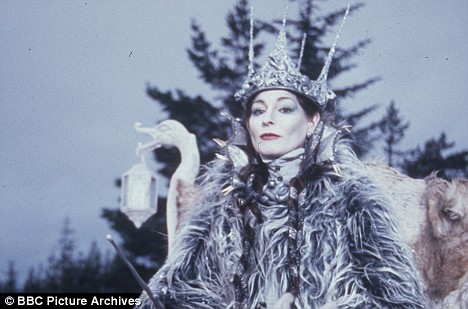
The Winter Witch is the archetypal evil stepmother - the "bad woman" who comes into the "good kingdom", wrongly taking power from the "appropriate man" and harming the angelic stepdaughter, who in some way represents the future and all good things. There's a lot of culturally gendered stuff going on here, about who should hold power, and appropriate roles for women. But it is in the lore, all over the place, and so we need to reckon with it.
One theme that comes out more modern adaptations is that the Witch figure has a legitimate axe to grind.* The lord annexed her father's land, or took away her kingdom, harmed her sister or her mother, or in another form, harmed her. Another feature is that witches are quite cool, actually - to be selfish, to be powerful, is sometimes what it means to taste life.
The Winter Queen comes in several guises - on the one hand, she is a weather spirit, but on the other she is a figure skilled in witchcraft and enchantments. I draw attention to this because the Landmother is generally not understood as any kind of witch or enchantress; but the Winter Queen is one of a handful of spirits associated with witchcraft specifically, and is more frequently understood as some kind of fairy than as a goddess.
I think of her as the bliss of new-fallen snow, the silver bell of laughter and delight when you are in a moment of pure happiness - for that is what magic is to her, the essence of joy - and that feeling in your gut when you meet someone terribly special, someone you want to like you, someone you recognise as setting off feelings in your gut which you know to be bad news, and yet you want this person's approval. The beauty of winter is always ambivalent
And I think of the immense cruelty of winter, its sparseness, its paucity. The myth of a wealthy queen eating truffles on furs while the people starve is a potent image throughout history and culture and, though there's a deep-rooted misogyny somewhere in how that myth takes form, it isn't inaccurate. People freeze in the water. The elderly poor can't heat their homes. Riverside houses flood, and cars crash in the snow. Most people find themeselves burdened by sleepiness, inertia, and dark thoughts. Some children spend the season living in a single hotel room with their family, and have no presents. Nevertheless, the wealthy of the world do nothing. We should not think of ourselves as immune to winter's cruelty.
Spirits
Here are the parts which, together, suggest the presence of a Winter Witch in the lore. This list is a combination of those who are more witch, and those who are more winter, but all told should give you the right kind of mood.
- Jadis & the White Witch (Narnia)
- The Calliach (Scottish folklore)
- The Wicked Stepmother (in many fairytales)
- The Snow Queen (from Hans Christian Anderson)
- Morgan le Fay (who is also a Magus, an unaffiliated magic-user, but particularly here for the narrative of Merlin being drained and entrapped, for an excellent model of a "wicked witch" in the lore, and for her vengeance on Arthur through Mordred.)
- Lady Bertilak (from Gawain and the Green Knight - a tentative association, of Lord Bertilak as a spirit of the winter feast, and his Lady a more unsettling, seductive presence. Morgan turns up in this story also)
- Beira - a Gaelic figure often associated with the Calliach, a winter hag
- Louhi - tentative, as my grasp of Finnish mythology is currently limited. Queen of Pohjola, the terrible north, with power over enchantments and shapeshifting. Louhi may be an alias for Loviatar, who is more clearly linked to (still Lunar-Stellar) death and disease.
- Mrs Coulter (Northern Lights) - not exactly a witch, but not not a witch.
- From history, think Marie Antoinette.
- The Lady of the Cold (from the Moomins)
- Morana (Morena, Marzanna, Marena, Mara, Smrtka) - from Slavic folklore. Traditionally, her effigy is burned or drowned to chase away winter and death
Wikipedia's page on Frau Holle is very good, but gives an overview of very many Germanic spirits that have been tentatively linked together over time. They're all in the currents of Lunar to Stellar, but need teasing apart. The night flight of witches is associated with Diana (Lunar, no element), and is not quite a sky goddess thing (it just happens in the sky); spinning, dark grandmotherliness and the deaths of children are a Fisher (Lunar-Stellar,sea) thing; the Queen of Heaven is a Landmother thing (Lunar-Stellar, sky), and that doesn't leave much over except the various names given in various German villages to a witchlike presence in the wintertime. And some of the "jollier" old women in this lore, the ones who bring presents and are ruddy cheeked, are Winter Kings, because we are broadly gender-agnostic and try to look at ritual function over parts. One element we could use is as follows:
Frau Gauden, also known as Frau Gode, Frau Gaur, Fru Goden, Frau Wohl, and Mutter Gauerken, is a being from the folklore of Mecklenburg. She is said to be cursed because she expressed to prefer eternally hunt rather than go to Heaven, and her daughters, who expressed the same desire, were transformed into small dogs who either pull her wagon or sled, or serve as hunting dogs. She visits the homes of humans during the Twelve Nights of Christmas and punishes the lazy while sometimes rewarding the virtuous or those who help her
Though that is too clearly a human moral myth to not need more work before we can pare it back to the fairy-spirit beneath.
I often place Galadriel as related to the Lightbringer - she is the Morning Star, a golden light, and if you really look at her role in the text, she is ferociously ambitious and independent. Nevertheless, Peter Jackson's spooky presentation of her is a good mood, and in the book both Gimli and Boromir are resistant to entering Lorien because of the stories of a witch queen there. And so, as Galadriel is very "large" on the map, this may be one of her aspects.
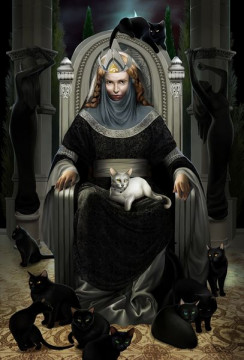
A better Tolkien fit is Queen Beruthiel, queen of cats - nefarious, solitary, and loveless
, known for her severe appearance and her heritage from sorcerous folk. She hated cats and hurt them; and then made them her servants, spying on people and winning at court intrigue. Beruthiel may mean angry queen
, and the marriage was childless. Tolkien namechecks snow giant Skadi, who was unhappily married, as an influence on Beruthiel.
Google images has comprehensively let me know that I need to consider Frozen, as a somewhat-linked-to-the-snow-queen story. I wasn't a huge fan of Frozen; I saw it the same week as Tangled, which really spoke to me. I don't remember the film well enough to opine on whether Elsa is a potential Winter Queen - she's too sympathetic a character to fit into the trend, really - but she is a queen, associated with the wintertime, and feared by her people, so people who love the film might want to explore this.
Appearance
Witches of this kind in the lore are always associated with glamours of appearance, and one should not trouble oneself overmuch about which of these faces is "true".
She is statuesque, elegant, sometimes wearing furs (but not the kind that keeps you warm, the kind which reminds everybody that you enjoy killing animals), and deathly pale (which doesn't necessarily mean a white woman, but intuitively it tends to; I'd love to see recommendations for art featuring "winter queen" characters who do not appear caucasian. Her skintone is cold, and a little unnatural.) She has an otherworldly fascination, which is not quite beauty, and a regal mien.
My image of her will always be the face of the Snow Queen in the book I had as a child. And something of the tale of winter, spiritual austerity, puts me in mind of byzantine medivalism, its sombre vertical lines and strange-faced saints. I tend to draw her in fantasy-medieval clothes with a realistic, historic tone (for example, covered hair and cotehardie), I suppose because she appears in the simulacra of an appropriate woman to wed and serves as a queen (for a little while), with her true might hidden.
At other times, she is an old woman, swaddled by cloths and furs and frequently, distinctively ugly; but rarely as a "grandmother". Fairytale grandmothers are in the domain of the Fisher. In fact, as much as I try to avoid reproductive metaphors in my craft, I would suggest that a distinctive feature of the Winter Queen is an absence of motherhood, an absence of things that grow or nourish; she creates for herself some children, but not by the usual way, because it is not in winter's nature to be fruitful.
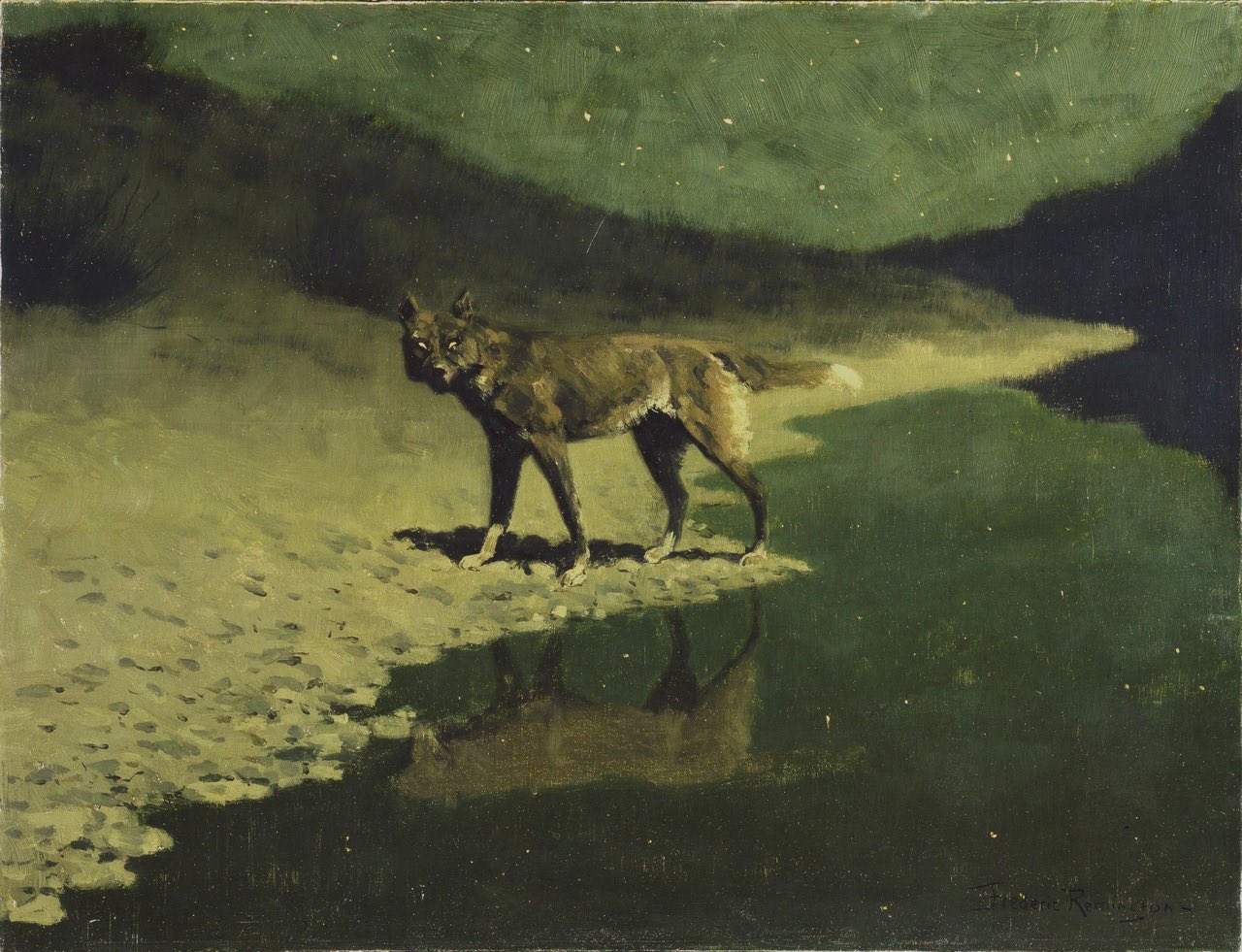
And as both Lunar and a witch spirit, she can appear in the shapes of many beasts (think bears, wolves, possibly pine martins or otters, probably cats). While the Winter King appears in furs which keep man warm in the winter-time, the Winter Witch's furs are the ostentatious cruelty of a fox-tail scarf. The two may be linked: the Winter King is the cornered old wolf and the brave, dying bear, and the brave man who faces them only out of necessity to protect his people; but she is the sated hunter luxuriating in the spoils of the kill; you have taken a life, and now you are going to wear it. Only one of them is getting out of the wintertide alive.
Domain
The Lunar governs several concepts for us - including "the witch" and "the fairy", entities that seem somewhat like a human, and are yet not like a human; entities which are neither hero-ancestor nor otherworldly presences and forces. The Winter Queen, archetypally, embodies this domain.
She is also elementally Lunar; something of the cold, fast-running streams across the barren rocks, something insubstantial and airy as of a snow in the air that melts as it is touched, something that could be made of light itself, spun silver and spun gold, a little bit of the stars and wan sun and the moon's strangeness, and slender like a white taper. Ice is the water that is a kind of stone and a kind of mirror.
We typically expect that when something is of a domain, it is also of the two either side, and this is true of her. Down into the Lunar-Stellar is her more frightening face, ice wastelands, famine and winter's horror. Up into the Solar-Lunar is her lightness (like grey dreaming clouds over winter's cold, gold sun) and a seeming-warmth in which we can honour her, sentimentally, as winter's lovely queen (as you may have gathered, in this guise, I feel immensely fond).
Colours
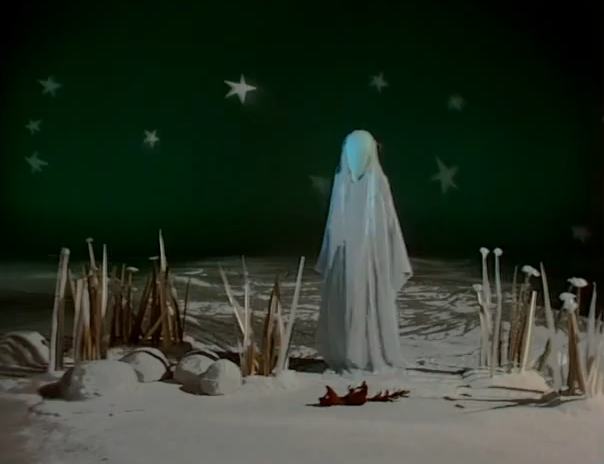
White predominant, with stark contrasts of deep or ice blues, or black, as minor colours.
The presence of gold or silver, or the mingling of both, is appropriate , as well as that watery grey-green that expresses coldness and silveriness.
More gold is more solar and, occasionally, she will have a touch of red or green when she is at her most mortal-seeming, to match the Winter King.
Foods
Paradoxically, I get a certain sense of richness here. For sure, to get a sense of winter's chill you could try cold pea soups and cucumbers; but the Queen herself is all about the best hot chocolate you ever tasted, and a tempting box of turkish delight. For calling her through, consider bringing out your "special" silverware you reserve for fancy guests.
I'm thinking that if the Winter King is hearty fare - roast potatoes, roast turkey, rich gravy, hot chestnuts - then the Winter Queen is those fancy little expensive things you only get in the supermarkets before christmas, like suddenly you can get the pate with the cherry sauce, and boxes of dates, and the little soft gingerbread shapes, and black trays of gloriously complex chocolate bites with unreal sensations within; the magical luxury of getting an orange in your stocking
Materials
As yet, I haven't identified any ritual tools or textures that are all that unintuitive. Consider: slender white tapers; silver tools, plates, candleholders (distinctly NOT iron, as we are in fairy territory); furs or faux-furs as you prefer; clear water, or ice; marble statues; treats; probably silver lametta or tinsel, if you can make it look expensive. Silver daggers, wands or sceptres. Sounds of chimes and sparkles and bells. Many of our spirits are called Prince or Queen as symbolic titles, but in this case it is absolutely literal, and so little crowns or dressing up well, or a small model throne.
I feel, moreso than at other times, that statues of the king and queen are called for (or, probably, some kind of papier mache doll i can throw together with old egg carton); I suppose, the sense is of having something in your house that you have to keep tending to and making happy, like a difficult relative at Christmas dinner. Winter comes like an unwelcome guest. Perhaps, for my future coven, we will have a Winter Queen statue to be passed between the community to share in the task of taking care of it all winter long...
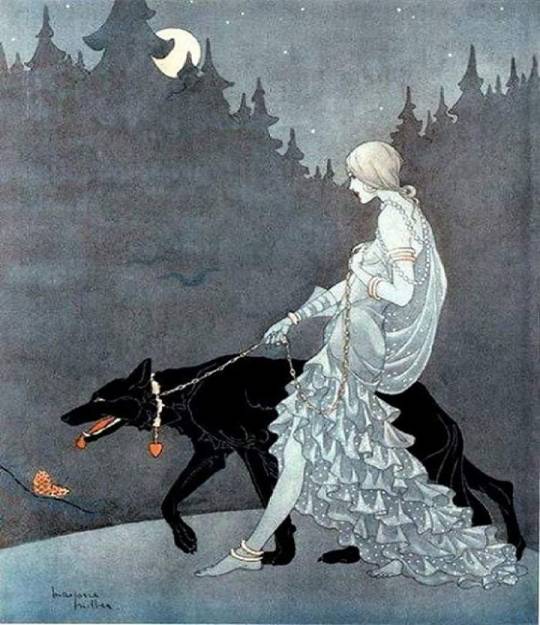
Queen of the Night,1931)
Other spirits
& the King-in-Winter
The King-in-Winter and the Winter Queen are very much a pair, the tension of the wintertide. He is charity, while she is cruelty. He is attempted abundance, and she is a wasteland. She is the ability to make merry in the snow, while he sits dourly indoors. He is bleak survival, and she is delight. Though to any human understanding, they have a very bad relationship, they make a powerful ritual pair, and can be summoned together or separately. On Christmas Day, he brings the feast and she brings the merriment; both are needed. When he is the focus of ritual, she can also be present in a Solar and sentimental form - supporting his meanings; when she is the focus, in turn, his role supports hers (he is weakened, useless, or feeble).
& the Landmother
To be considered as a pair especially around Imbolc. The twin-mirroring of the Lunar is expressed here, by two figures that are something to do with unpleasant weather - the implacable coldness of the Winter Witch, and the somewhat-more-mollifiable might of the Landmother. Understanding the pair in various ways (sisters, lovers, shadow selves, and so forth) bring different insights.
& the Lightbringer
The Winter Queen is, tentatively within the mythos, the parent to both Lucifer and Diana (who are, firmly, twins), and the stepmother to the Changeling. That still feels more in the territory of fairy-story to me (albeit a fairy story that I have written, instead of somebody else), but it's been true in the lore for several years now, and I've seen nothing to deter me from it.
The Lightbringer is humanity's perpetual outsider; Solar enough to be close to man, involved in the Sun King's court, and want better for the Village; and yet Lunar enough to be always set-apart, to be not-quite-a-man among men, and to be the dissenting voice. It is fit, therefore, that he be somehow part-fairy, part-man. He is placed to be the heir to the throne, but will never be seen as acceptable for it - a constant first-alternate for the role of king, a compliment or opposite to the Sun King. In Fencraft, we split out the God's traditional joint role as both the sunshine and the greenery, and so the Lightbringer lurks at the fringes of the Sun King's court, the king-that-could-have-been. In this, I think I'm influenced by Mordred (and particularly, Mordred in golden armor in Excalibur), but also the Biblical myth of the rebel angel (who is in challenge to Jesus, the 'true' son). The Lightbringer's position, then, as sort-of the heir apparent, but not quite the legitimacy to take the throne, makes sense of his dubious parentage.
The Wiccan myth tells of two figures who circle around one another - as discussed above, I find it unsatisfing and not my experience of how the land-infinite-year feels. In this traditional wheel, the Winter Solstice is the celebration of the rebirth of the God. This feels straightforwardly incorrect to me: December is not the end of winter, winter then drags on for an interminable age of darker days. As we split out the Lightbringer and the Sun King's roles, we can more clearly celebrate Solstice as the turning of the sun but not the green. And through December and January, one can feel his austere hope and courage beside you and ahead of you that the sun's warmth will come, but only after its cold brightness. For the Lightbringer is hope of that-which-might-be and courage to seek it, but never enjoyment of its fulfilment.
& Diana
Diana as Lucifer's twin is drawn from Aradia, the moon and the sun, and fits into my reading of the traditional witchcraft, where witch and devil are intertwined rather than hierarchical. And yet, my understanding of her is very sparse, somewhat empty - the shape of what ought to be, without fullness. Closer to the mechanical than the natural, more neutral than evil, more of a part of humanity, and a middle-point between human and fairy power. As the archetypal witch, Diana is not seasonal and I think that's why she does not seem so linked with a cycle of the Winter Solstice
because, as standard, Lunar things and witches and fairies are not seasonal, not land spirits, and therefore do not wax and wane in response to the seasons - they are omnipresent, and we know this as witches because our power does not wax and wane).
Nontheless, Diana as the cold moon in winter, daughter of a fairy-witch, is very much true to her myth
& the Changeling
The Changeling is the spirit of the fairytale princess, and so she needs an evil stepmother. Again, her position at court is a strange one - she is linked to the abundance of her father, the Winter King, to bring the abundance of spring flowers and autumn fruits; and, like Lucifer and Diana, has this quality of being human-ish-but-linked-to-the-otherworlds; and like Lucifer, she is the returning sun; and like Diana, a witch in th woods. However, she is not cold. There is a Percha myth, which I found once and then never found reference to again, where the runup to Beltane is a series of Wild Hunt nights in which the springtime flees the forces of winter and has to make it until May Day. If I ever get my head around this, it'll be something to do with the synergy between these two spirits.
Timeline
My sense is that the Winter Queen, as a benevolent force, is dominant in November, which is currently something of a gap in the year - but certainly witchlike, a time for the Lunar and the Lunar-Stellar to come through. I do not yet have a date set for the "arrival of the Winter Queen", but there will be one in the lore somewhere. But this year I have been thinking of her all throughout October.
In December, her presence is somewhat diminished in the ritual calendar unless she is your ritual focus. December is dominated by the King-in-Winter as Lord of the Feast, and the coming birth of the Lightbringer (who is celebrated on the Winter Solstice and the first day of the new year). She is present as a consort, a lovely and Solar face.
After Christmas and across January, she is once again the dominant force, but her character is much darker at this time and propitiatory rites might be more appropriate than celebratory ones. As i've recently been reminded by The Dark is Rising, traditionally the powers of darkness were at their strongest until Twelfth Night
She leaves the cycle at Imbolc, where the Landmother comes once more to the fore. There is, perhaps, call for a "defeat of the Winter Witch" day, and yet the winter never feels like that, does it? Never a triumphant, final strike, but a slow ebbing and retreating. Imbolc is the Landmother shutting the gate, or the strange magics that balance them making the one impossible now the other is here. The defeat of the Winter Queen is more of a passing on and falling back, and perhaps we mark that merely by turning our attention to other spirits more surely as the new year takes hold.
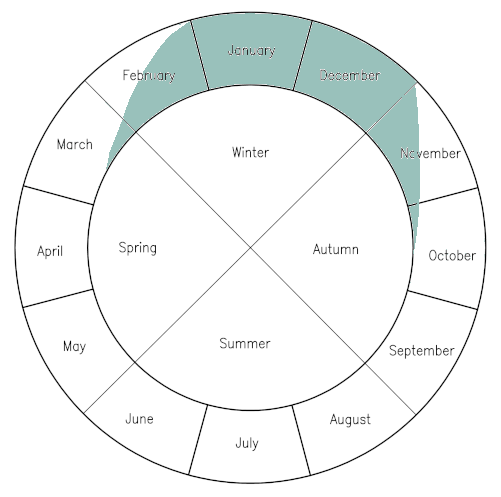
- November - Winter Queen begins to be present, as cold beautiful nights.
- December 13th - Feast of St Lucy - tentative 'coming of the Winter Queen to the King's Court' day
- December 25th(ish) - Winter Feast
- January 1st - Lightbringer's Day, tentative 'triumph of the Lightbringer' day
- January 7th - just after Twelfth Night, tentative 'defeat of the Winter Queen day'
- February 2nd - Candlemas, and final retreat of the Winter Queen
- March 21st - in Morana traditions, this is the date on which the effigy is burned and springtide takes over. I feel this is too late for us, but am noting it anyway.
Why should I call her?
The Winter Witch is in an awkward middle ground for Fencraft. On the one hand, she's a personification of a time of year, but on the other she's a fairy - so not quite part of a cycle of ritual behaviour, but a kind of person.
Call her through the gate
As part of a seasonal cycle, a festival of the arrival of the Winter Witch is marvellous - preparing as you would for an honoured guest, celebrating her attributes, and making that connection at the start of a long cold season.
As essentially Lunar-Stellar, she is in that group of spirits we treat politely because we must and they are terrifying; which I've always analogised to the sort of Christmas Day relation who is going to be invited whether you like it or not (and indeed, there is a precedent for this: in Sleeping Beauty, the evil fairy's ire is roused by being rudely excluded from an event she could have expected welcome at for feudal reasons. If it is appropriate you invite her - and it is winter, so it is - then do.)
Propitiation / Celebration of the weather
Ask for blessings and protections at the time of year, or give thanks for the beauty of winter things. Think of her when the night is grim and find something to love in it. And, of course, the sublime wonder of a snow day if she gifts you one.
In my life, the Winter Witch is less a icing-sugar dusting of whiteness on the land, but a murquoise dust of blue-and-white mould softly settling on my furniture and food.
Welcome Mighty One, but please not here - be in the place I have prepared for you, which is lovelier by far - for you are Winter's Queen and its delight, and this is but a humble box of decaf tea forgotten at the cupboard's end. Our Lady of The Black Mould changes everything She touches, and everything She touches changes - make the woodland brilliant with beauty and the night sky alive with stars, and spare me spots of white upon my bread and jam, as I call on you - humble in the dark.
Witchcraft teaching and alliance
Fencraft's basic theory of magic is that it derives from more powerful spirits which we can work alongside, and so identifying (permanent or temporary) "witch patrons" is important. As well as power over the weather, her fairy affiliations suggest glamours and enchantments, and magic connected to luxury and pleasure. The Winter Queen is at heart, a fancy wealthy lady, and knows the secrets of those lovely joys
Seasonal prayers to a ritual pair
Acknowledging the Lady and Lord at this time of year is a simple, Solar-flavoured rite, in which addressing both is prudent, in the hope they will remain in balance and cordial so that the people might flourish in this time.
Landmother in Winter
The Landmother, in her role as queen, is absent at this time of year - though to my mind, she is not dead as the Sun King is, and can be sought out still - but is not at the height of her powers. The Winter Queen can carry many of her associations through the wintertide, such as the truce, the sacrifice, and placating the weather.
A Meditation
Close your eyes, and concentrate on the sensory of winter
Frost forming on your breath. Cold nipping at your fingers through gloves. Snuggling up under warm fur duvets. The taste of rich, festive chocolates and spiced wines. The shock of icy water in a brook. The magnificence of stars in the night. Sleigh bells. Wolves howling in the wood. Snow falling through the air. The fog settling on pine trees. The trace footprints of some creature you are following. The pale moon lighting up the snow. The slipperiness under foot. Cold marble floors. The brilliance of fairylights in the dark. A furred creature up ahead in the woodland.
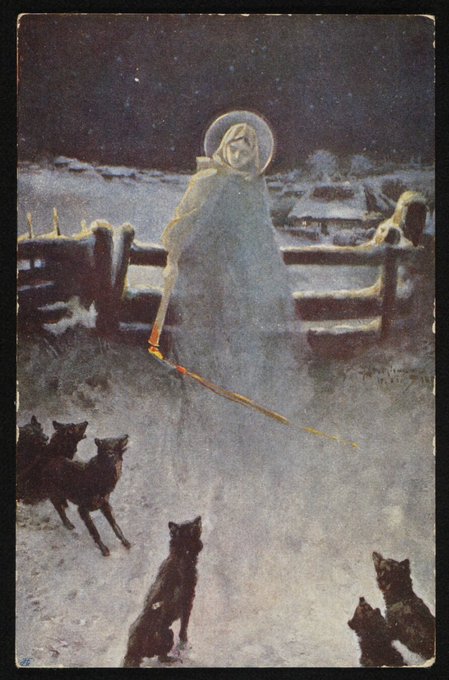
Our Lady of the Thunder Candle Cycle, 1893)
Reading List
There's a lot of overlap here with Winter King media!
- Gawain and the Green Knight (original text or Rudkin film; I can't really be doing with the 2021 film, unfortunately, and the imagery of it leaves me cold)
- Excalibur (not really a wintertide watch, but if you've not seen it before, focus especially on Helen Mirren's marvellous Morgana)
- Narnia (First two books especially; I wasn't wild about the BBC adaptation. I have not seen the most recent film for some time.)
- The Snow Queen (Hans Christian Anderson)
- Arctic ambient - zimina's excellent list offers suggestions for albums providing icy textures for ritual or meditation.
- Any fairytale (book, film or other) with an evil stepmother: Snow White and the Huntsman, Sleeping Beauty (Disney) and Snow White: A Tale of Terror are three good options.