What I'm Listening To...

March 2023

Changing Trains (1982)

Sounds of the Steam Age
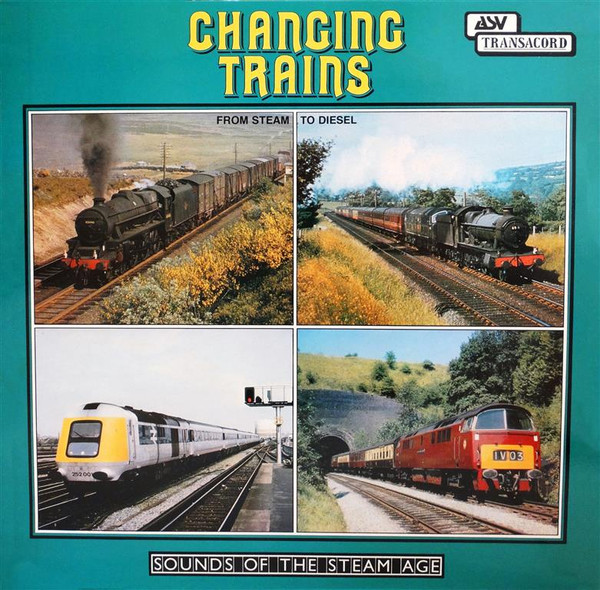
Fencraft is about the wonder of going places and a certain Englishness. Could there be anything more central to that than a fantasia of trains? The promise of a summer at the seaside, nostalgia for nationalised industry, the pleasures of everyday design in the station signage - having a cheese toastie in the tea room, pretending to be Trevor Howard, slipping backwards in time along historic ways and feeling the ghosts of passengers and workers there. In your heart, it is always a steam train - even when it is not - and you might be carrying some kind of beautiful trunk containing all your hats or books, or travelling with a secret companion, or on the cusp of an adventure to which the train is a mere psychopomp. Of course, to jump on a train is impossible under Conservatism, where a same day ticket to anywhere lurks around £100 - but oh! if it were not...?

I am closer now than I was to having a room which supports me: all my collected knick knacks are finally out of storage. I have my Victorian fireplace, my dolls houses, my 1970s ceramics, my big olive green granny carpet and a grandfather clock; I have my old photographs in tatty frames, junk shop dolls, small model owls, an electric organ, a birdcage. Fencraft HQ looks, at long last, as you might imagine it: like the smoking room of an out-of-the-way B&B, from which you - travelling scholar with a youthful, foolish air - are about to discover something horrifying in the local woods. This recording collects such compelling tracks as Night on the East Coast main line, at Grantham Station in 1961, and it fills the brown loveliness of my room with the haunting moans and chugs of long-forgotten trains and, in the backgrounds, the occasional bleating of sheep. On the back of the record, terse paragraphs describe what it looked like when the sounds were recorded. As I write this, it is cold, and filled with a sense of springtime: the let's-all-jump-on-a-train-and-go of the year.

In the internet age, sound generators and ASMR have flourished - but when this record wheels to an end, the silence is utter. I hate it. There I was, at Princes Risborough Station, on the last day of passanger service on the Watlington branch line, in 1957, and with a jolt I am suddenly back in my little room. Ah, says my husband, but that's the purpose of the medium. When you watch a film, it is essential to sit through the credits to stay within its mood and process; but when you listen to a record, that silence is all.

I am a big advocate of media piracy. I believe we should be eschewing Spotify and Netflix and the rest, and relearning the skills of our ancestors: how to torrent. What I save up by doing this, I put towards independent media whenever I can (which is less often than I'd like). The last new record I bought was Adlestrop by Gilroy Mere, which came with a paper cutout toy of a model train station. It was released by Clay Pipe Music, who are cultivating a definite English whimsy - we are weak for Gill Sans and they know it. As often as not, I love their releases more for their promise and their artwork than the music within. But Adlestrop is a tribute to 'The Age of the Train', based conceptually around the train stations which were closed in a 1960s reform. It has a gentle folky mood, putting me in mind of Virginia Astley's hauntological pastoral, and of a businessman who comes to the end of his working week, folds up his umbrella and his newspaper - but on getting to the station, chooses not to take his usual journey home. Instead, a mood steals up upon him - unwontedly - and he finds himself upon a platform he has never seen before. As the fields open wide towards the coast, he feels a giddy sense of the forbidden in this stolen hour. When he gets to the seaside, perhaps he will roll up his socks and loosen his tie, or risk himself an ice cream. And then he will get back on the train, and go home.
October 2022

The Gereg (2019)

The HU

Huuuuuuuuurrrr HURRRRRRRRRRRR hurumhurmhurmhurmhurmhurum HURRRRRRRRRRRRRRRRRRRRR!!!!!!!!

Neofolk is the most maddening of genres. A seductive blend of folk, electronica and metal which from its inception has been so saturated with neo-Nazis it's the exception, not the rule, to find a band I can fall in love with. There's no real reason why mixing traditional and modern instruments with historic fantasy need have a particular political orientation. Perhaps part of the appeal of the HU is the relieving deniability of knowing far too little about Mongolian politics to know for sure if the Ghengis Khan Biker Gang Wolf Totem Ancient Empire Honour The Ancestors Make Traitors Kneel guys are bad'uns, doing nationalist satire, or doing the Good Nationalism of a persecuted people under threat. Right? right.

The HU match a familiar neofolk pattern, but with their local twist - inspired by the nomadic Hunnu, and using traditional Mongolian techniques and instruments - like the horsehead fiddle (morin khuur) and Mongolian guitar (tovshuur). Any time organic instruments go where they're not supposed to, I find it irresistible - prog with flutes, orchestral rock, and this. The band describe recording against the the mountains in Khovd Province - which I can only imagine, but something of that spirit remains. You can hear it: the echoes, the elation of birds, the motion of wide cloudshadows, something about the rollocking thump of their rhythm feels like turning into a roar of horses.

The HU is fun. Metal is too often hollow and cold and clever and alienating for my tastes, but something about the HU's sound is joyful. Take Yuve Yuve Yu - with the jolly bounce of indie punk - you cannot merely mosh to it, you can bop and then you can huuuurrRRRRRRRRRRRRRRRRRRRRRRRRRRRRRRRRRRR. Guttural roaring has always been a feature of metal, but that style is trampled underfoot by the awesome wall-of-power of harmonic throat-singing which makes you want to vibrate with delight. The connection is superficial: compared to western heavy metal vocalisations, it is warmer, richer, less hostile-feeling and abrasive. This is not the cathartic howl of despair, but joy. Something in the melody of the Gereg feels like a smile; and even the most warlike Wolf Totem has a sea shantiness and you are part of it.

There's not a dull moment or a dud song on this. The secret to the HU's success: it just sounds so good. I love the album's structure too - slamming from the start, and then taking you down to its more reflective, expansive and peaceful moments at the end; from warrior pride to peace, from a day of boasting and riding to a night around the campfire - looking once more at the land you love. It reminds me a little of the Viking myth of Ragnarok - after the final battle, there will be a peace.

Sept 2022

Raise the Roof (2021)

Robert Plant & Alison Krauss

Led Zeppelin 1 starts with a climax and goes nowhere but up. In contrast, Plant's beloved blues start at a 5 and stay there, seductive and stubborn until you've lost all sense of time and dissolved into a blissfaint. Blues is a slow spell. Krauss is best known for the otherworldly Down to the River to Pray, and the chaste sonic edging of Didn't Leave Nobody But The Baby. Krauss, Plant and the Devil truly do make three - and I'm ready to wade right into the warm waters with them and drown there.

Quattro and The Price of Love feel unexpectedly elven, folk traditions intermingling to suggest there's nothing more natural than Lothlorien bluegrass. The ghostly You Led Me to the Wrong is perfect southern gothic: a man about to die for a murder, unsettling with the horror of both his fate and the and the lingering possessiveness over a woman. I'm a little bit obsessed with the drum here: a huge, devouring thump you feel in your belly, like sinking into a feather bed; as well as the sly bisexuality of so many songs in which a male and a female voice duet about the same lover, like eavesdropping on a friend's byzantine poly hell.

I think about the Solar-Stellar: 'It devours you, but it feels good'