On Disconnection
Our Powers were first honoured in circumstances very different to ours. When I walk in the woods, I fear groups of teenagers more than the trees. We can dance for the grain – but can we really slip into the otherworld without need for it? We love the natural world – but do we fear it? This is not a utopian, pastoral fantasy: far from it. Life was hard. By learning to experience our lives the slow way, we can more easily comprehend the Powers they revered – and encounter them in all their immensity.
Disconnection is acts which take us closer to our ancestors’ sensory experience of the Land. It is our ability to consciously disconnect from some things, in order to begin connecting to others
The point of being here is to be here. An hour or two into my time in the forest, I wrote these words in my notebook, and drew a box around them to emphasise their authority and self-sufficiency. And then I stopped writing words in my notebook altogether, because writing words is my work, and I was wary of taking an utilitarian approach to the solo. The point of being there, after all, was to be there. And what did I do, while I was being there, in the forest, by the river? Nothing, more or less. In these moments, I find myself thinking of the place itself as somehow conscious of my presence. To be alone in a forest, and to be thinking of the forest as somehow aware of you: I will acknowledge that this sounds like the very substance of nightmare, but, in fact, it is a strangely beautiful and quietly moving experience, and I think it must be what people mean when they talk about intuiting the presence of God.
Mark O’Connell
Apologia
My primary Disconnection practice is rooted in times of absence from the internet, and personal rules to ensure my use is nourishing and balanced; and from there, the lessons it taught me. I'm aware that this is going to be a sticking point for a lot of readers.
First and foremost, these notes are a description of what I do. I'm not delivering a generic Pagan set of precepts (or expectations for how an ordinary person must live), but a specific toolbox: this is how I have done what I have done. For me, consciously managing my relationship with the web is essential to any kind of good life, and spirituality is a traditional way for humans to cleave to their values. Doing the work of being offline was essential to my development, and made the space for all this to come to be.
As you can tell from my hand-tooled website, I don't believe the internet is bad
- on the contrary, I care about it very much, and that's why critiques around it matter so much to me. A thing that is bad or without value can be dispensed of easily; it is only a thing that is good and flawed that prompts this kind of intensity.
Keep reading: I am going to discuss the tensions of this work more as we continue. I'd like to ask you for the generosity to stay open to it - to read this section fully and consider it, and also give it a go as a practice before rejecting it as worthless.
Why Disconnect?
Disconnection is a purposeful activity. Understanding why we do it will help you develop your own Disconnection practice effectively, by learning the kinds of states and experiences we wish to trigger.
Make Space for the Landweird
One goal of Disconnection practice is to make empty, contemplative spaces in our lives, which we can then fill with the sensations and strange ideas which crawl up on us from the earth and sky. Visionary artworks, religious hysteria, fire-lit cavepaintings, fasting, journeying, enlightenment, bliss, mosses, mushrooms, becoming more beast than man: these intense spiritual experiences are the rewards of the equally intense spiritual isolation which makes room for them. Seeking these altered states are the Stellar path, and the first step is to practice being profoundly present.
Being offline is quiet. It is strange to think that monks and mystics have chosen to live in isolation for thousands of years, even though their lives were far less bright and loud and fast than ours today. Being offline is boring, lonely, isolating and difficult. One becomes instantly aware of just how much of life is mediated through it.
Stellar Changes of State
Paganism is experiential – and this is especially true of Disconnection. You cannot learn its lessons or gain benefit from merely reading about it. I wish to emphasise that this Practice is not a nag or a lecture, nor mere luddism, but a technique you can use to profoundly shift your sensory experiences.
These kind of conscious state-changes are an inherently Stellar activity. Disconnecting from the internet can cause us to experience distance, time, emotion and life in strange and unusual ways. Disconnecting from public transport, supermarkets, newspapers produce varied effects in our perception. It’s not that the new experiences are better
or more spiritual
; it’s simply of interest that we can do it.
Make Space for the Star
A key part of Stellar magic is the ability to consciously shift your perception into strange altered states. In later chapters, we will discuss memory triggers, sex, enethogens, fasting, dance and other techniques as Stellar roads to the divine.
Disconnection is an everyday way to create an altered state: looking at your garden, say, as not a hobby but a survival tool; or, looking at the distances between places differently; or experiencing time in a different way. However, it’s also true that the internet specifically is extremely distracting.
In most magic, ritual is preceded by bathing or meditation to cut off
and cleanse
any odd grot that’s got into your aura. I dislike this, in part because the concept of 'purity' is so overtly fascist[1] in the original Occult authors promoting it; in part because bathing is a high spoon activity for me, and not viable if I wish to get ritual done. In this sense, Disconnecting from the internet specifically clears a gap in your mind and perception which you can then fill with new experiences more vividly.
[1] see The Occult Imagination in Britain, 1875-19 - Radford, Andrew; Ferguson, Christine - esp the essay on Dion Fortune.
Make Space for other Practices
I discuss this in more detail below. In practice, disconnected days are an excellent time for Walking and Reading to be done: you will simply have no idea of how to fill the time.
Pagan paths can be followed at any intensity, but you do need to clear at least some space in your week - choosing something you value less than the work you are about to undertake.
"Britons will spend the equivalent of 22 years, one month and four days of their life online. A poll of 2,000 adults found the typical week will see 59 hours – the equivalent of more than two full days - spent using the internet."
- How much time do Britons spend online? by Alice Hughes of the Independent (Thursday 22 April 2021 18:18)
The more Stellar your practice, the more essential this is - to become somewhat more of the forest than you are of the fields. By its nature, the Stellar is not balanced time. The Solar Path refers to the kind of spiritual life integrated within the everyday, where religious and magical acts are woven into daily life so it is all the brighter. When we speak of the Stellar, we mean things sacrificed to become very peculiar. Odin hung nine nights upon a tree for wisdom; you too, o seeker, can give up something on your quest.
Disconnection is the work of boredom (and you will be: very, very bored) because that state best prompts seeking, experimentation and chance encounters; and I find I rarely regret that time.
In great part, the act of Disconnection was inspired by not one but THREE of my influences, abruptly choosing to go offline (this is Dver of Aforestdoor; Sarah Anne Lawless; and Root and Rock). This alone was a clue for me that, if I wanted to follow in their footsteps, I should also consider this. I spent periods of time without internet access accidentally, and found it very helpful – both for spiritual purposes, and an opportunity to pause and refine my ideas without sharing them. So, I’m choosing to enshrine it as a thing one ought to do more of. I wouldn’t be where I was with my craft, had I remained online. Most of my writing on the website is done long-hand first, getting my morning thoughts on the page, and for the pleasing tactility of getting to re-read my own notes as if they had been sent to me from a stranger.
Going offline draws attention to the way the web flattens life: one can move across the globe and within moments return to familiar websites, which are really a kind of place, which we cannot leave. It distracts us from the particular and the hereness of here, not unlike the horror of every high-street being dominated by the same familiar chains. As an faith with roots in bioregional animism, cultivating a sense of hereness is essential.
To be sure - the internet is a revelation because 'here' is so often a bit shit. I do not live where I wish to be living, and yet I feel extremely political about the hereness of my little village. I try to avoid just looking to the local urban centers for culture and entertainment, as well as living a digital existance to shut out my reality - and because of that choice, I've been blessed with local transgender and pagan friends, plus a rich world of mates and chance encounters with acquaintances at my regular pub, high street, the OAP hall hobby groups, and the other local dog owners. In short - being within my community, and doing my little part to make this a great place to be. That's only really possible when one starts with the refusal to stay indoors.
General Wellbeing
Disconnection began with my personal discomfort of the internet and my recognition that periods spent offline were helpful for my spiritual growth & wellbeing generally. Man was not born to be involved with the breaking news of the whole world at once. Being offline gives ideas time to percolate before they are shared. Being more offline is better for your posture, your hand health, your eyes, and so forth.
Meditation
By design, Fencraft does not ask you to begin by learning to meditate. But you can think of Walking, Reading and Disconnection as in some way equivalent. The meditative quality of being offline is practicing your ability to resist a temptation and get your mind empty of interruptions.
In both tests, the subjects whose phones were in view posted the worst scores, while those who left their phones in a different room did the best. The students who kept their phones in their pockets or bags came out in the middle. As the phone’s proximity increased, brainpower decreased. It was as if the smartphones had force fields that sapped their owners’ intelligence. In subsequent interviews, nearly all the students said that their phones hadn’t been a distraction—that they hadn’t even thought about the devices during the experiment. They remained oblivious even as the phones muddled their thinking. A follow-up experiment, with nearly 300 participants, produced similar results. It also revealed that the more heavily the students relied on their phones in their everyday lives, the greater the cognitive penalty they suffered when their phones were nearby.
In summing up the findings, Ward and his coauthors wrote that the “integration of smartphones into daily life” appears to cause a “brain drain” that diminishes such vital mental skills as “learning, logical reasoning, abstract thought, problem solving, and creativity.” Smartphones have become so tied up in our lives that, even when we’re not peering or pawing at them, they tug at our attention, diverting precious cognitive resources. Just suppressing the desire to check a phone, which we do routinely and subconsciously throughout the day, can debilitate our thinking, the authors noted. The fact that most of us now habitually keep our phones “nearby and in sight” only magnifies the toll.
The Shallows - Nicholas Carr
Demonstrating Mastery
Doing Stellar magic requires a high degree of confidence and control: you will be losing yourself in intense states, and entering the presence of mighty entities, and you will need to assert your ability to come back. The ability to break a compulsive behavior at will is no small thing.
Stellar narratives often include an unusual level of commitment – for example, daily practice ahead of climbing Everest, or long periods of hermit’s isolation, or entering the Underworld.
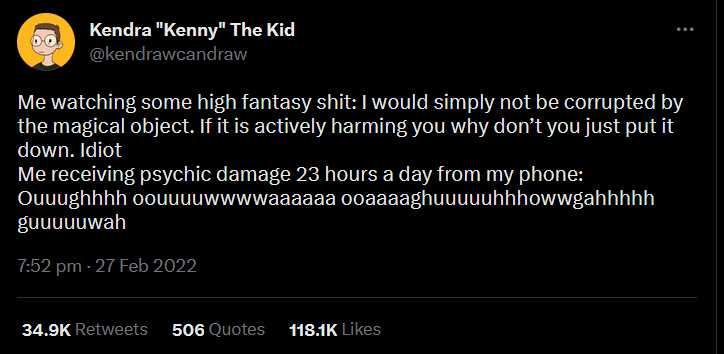
The average person touches their phone 2617 times a day; the heaviest users, 5427 times. Arguably, there's something of the cyberpunk about this - an extension of the body, and the phantom-limb-like adjustments to the psyche to incorporate those new capabilities as part of our Self. To be clear: this could be very cool; but the texture and patterns of the internet of phones is so dominated by corporations hostile to human flourishing that we can't uncritically celebrate them. Unlike the ways that the clock, the map, or the printing press influenced human cognition and perception, the internet is in a constant and active process of design by entities immesurably more powerful than the average user. App designers deliberately set out to distress and addict their users. So long as this is true, we must refuse to play - demand the benefits of the web while beating those patterns - and dream of a better internet to come.
The Sacredness of Forgetting
England has forgotten its gods. Pagan traditions handle this quandary in different ways, often reconstructing what they can from what we have, or in Tolkien’s case, reinventing it entirely. We choose to recognise and revere the fragmentary, contradictory, unfinished, overlapping nature of our lore as part of its Mystery, part of its appeal.
The internet’s ability to infinitely record and recall things is a threat to the sacred distortion of memory, to the act of misremembering. Our god of the gaps needs the gaps to exist in.
(To be clear on this point: I'm not saying that information is never good, but that this faith has memory and fallible memory and recordings and fallible recordings, and what it feels like when those processes break down, as a central theme. The internet is therefore of high interest: both in how it diminishes the urban legend, as well as creating new opportunities for it.)
Having too much information leads to reading instead of trying, as well as shopping about for a perfect tradition where maybe doing whatever the only library book you can find suggests will take you further. Historically, so many of our faithpaths were mystery traditions - or, had particular kinds of knowing and doing behind secret gates. We should never crave arbitrary mortal structures of power, but we do lose something to wikipedia - how it flattens, how it tempts us to see the divine as taxonomic instead of living.
Many things are simply not online. If one is overly online, one experiences a new form of erasure - the seen and the unseen are determined by its particular shape. Eskewing streaming music and video, for example, leaves me hunting down recommendations in other ways - following a different set of paths. I attend events more by word of mouth or going for a walk and wandering in than by pre-planning; and often, people with something to say are simply not saying it on twitter. And so the sense that everything is available there isn't even true. As of 2019, almost 1/5 of Britons report that they do not use the internet - predominantly older people. 40% of those earning less than £12,500 do not go online.[3] That is to say - when one assumes anything and anyone worth knowing is connected, one is choosing to be unhearing.
[3] 'Almost one-fifth of Britons 'do not use internet' 9 September 2019 by Mark Ward
Know where to come back to
Most Stellar rites involve some kind of self-loss/out-of-body technique. But for these to be effective, it helps to be in your body to begin with. If you’re going to do trance, journeying and landspeaking on the regular, it’s good form to know what being truly present means. Being embodied, being in control of your sensory experiences, being able to tune in and out of sensations with some degree of mastery: it’ll help you choose these experiences, and taste them fully.
The internet specifically provides us with a degree of ambient not-here-lessness. But if you were never here to begin with, how can you know when you’ve left and where you’ve gone?
The Presence of the Past
A lot of Pagan paths hark back to an imagined “past” – costumes, swords and herbal medicine. Let’s talk about the role of the past in Fencraft specifically.
The Landweird is the land’s strange memory of itself, which violently interrupts the everyday when one is caught offguard in out-of-the-way places. Our gods are half-forgotten and fragmentary. For this reason, we revere the act of both memory and forgetting, and we are extremely interested in time – especially its distortions and disruptions. It is not unusual to go on a ramble between the hedges, and end up in a different year entirely. Just as we honour the experience of getting lost, of suddenly becoming disoriented in space; so we honour the feeling of becoming unstuck in time. And we seek to create opportunities for this to occur.
“Serious” Occultists often make fun of pagans who dress up, and they are foolish. As part of our call to play and re-enchantment, Fencraft joyfully endorses dressing up of all kinds – from masking and mumming, to ritual robes, to aesthetic magic and empowering your everyday look with an otherworldly edge.
But disruptions in time are also a very serious and integral part of our spirituality. Dressing up in capes, and wild-camping, cooking fish you caught that day over a fire: this is not just LARP or holiday, or an expression of traditionalist political values, but a way to turn back time. This can be an entryway to encounters with the Landweird. Reading on this that comes straight to mind includes Doctor Who: The Awakening and Sapphire & Steel: Assignment 5: it's not uncommon in fiction for interaction with old objects, or recreating a historic event, to awaken those loops still-living in the landscape and prompt a fracture in time through which we can pass. We're less interested in being in the past, than on the sacred magic of time-travel itself; and on how a simple walk through the village can become time travel in our noticing the long life of the land and its left-behind traces.
And it can help us recognise the power of the Star, by recreating the daily challenge (and consequent awe and terror) experienced by our ancestors. Nothing says Stellar like a fire that won’t light.
In short, we encourage the pleasure of dressing up and make believe if it is your thing; but there are coherent spiritual reasons for us to create these experiences too.
Disconnection & Other Practices
Initially, I understood the Sun and the Moon to be each other’s opposites: to be exact, the Moon is the Sun’s strange reflection. We can see this in the Practices: going for a picnic outside with friends, vs sitting indoors alone with a book. The Star is strange, and often interacts with the other two powers to create overload or inversion.
And so it is with the Practices – Disconnection is intertwined with both Reading and Walking, but doesn’t oppose either. You could think of Walking and Reading as “offence” to Disconnection’s “defence”. Disconnection clears a space + keeps things out, which Walking + Reading then fill.
Walking
Disconnecting helps your Walking. As your mind slows, your ability to be present and satisfied in an empty landscape grows. Watching the view from a bus or standing at the bus stop is enhanced by the practice of disconnection which insists you spend that time just stood there. Making food, candles, clothes can be both Disconnection and Walking: you’re engaging in a creative, bountiful, physical act AND rejecting easy availability at the same time. Disconnection, paradoxically, spurs time connecting to others. One becomes very lonely without the constant low-level presence of companions, & craves times spent with people far more richly. Taking your family out for a no-tech walk and picnic encompasses both practices.
(and by the constant low-level presence of companions, I don't mean fulfilling time spent with your online friends - I mean the loneliness of uni-directional browsing, where you are not exactly talking with anybody)
Part of Walking is aimlessness; walking for no purpose; being in places for its own sake; not rushing, not accomplishing, not progressing; walking in unusual places or times, ways which are not prescribed – walking at night, walking home from work when others are rushing, walking without destination. We can link this to Disconnection’s conscious refusal; its choice to take the slow, round road over the fast one. You can buy bread or make bread; listen to your infinite choice of song or take a risk on the radio; drive home or walk. All of these acts reject the straight way for the curious to see what we might find there. All of these acts too reject efficient and productivity – we are to live, not work. We are not workers or defined by our relationship to it. We reject the idea of slow or pleasurable time as “wasted” time. Much like Walking, I can never guarantee a given Disconnected act or time will lead to profundity, but this is part of the Practice. What does it mean to choose unproductive time?
Reading
Disconnection and Reading is harder to parse: because connection gives us access to reviews, shops, and free materials beyond our hopes – rare grimoires, say, and unusual televised artifacts. How do we resolve this?
Disconnection is a way of relating. It is conscious, not passive – boiling tea on the stove, not a kettle, even though the tea tastes the same. Refreshing witch tumblr is not Reading. Mindfully planning to Read a pdf or article series and shutting the desk when this is done, is. In other words, relating to it as you would a book or video tape rather than an endless wall of Content. I have increasingly preferred to print texts and Read them on paper, and keep them in physical collections for reference, or using an eBook reader – looking them up is always a risk for consuming them as Content instead of actually Reading and engaging with it.
Always ask:
- What good am I fulfilling by being online?
- How do I tell when this task is done?
- Is this the best or only way of meeting this goal?
- What is my emotional state? Am I hungry, lonely, tired?
- Am I using this tool as a tool, or as an end to itself?
Disconnection can also help us reconnect with the pleasure, ability and time to read a whole book.
Part of Reading practice includes acts of creation: writing, making music, painting. Absence from the internet can help us refine these works + resist the urge to publish + especially to sell them (look: Tolkien spent 7 years on Lord of the Rings and a lifetime on the Silmarillion.) It helps us experiment – not everything need be final product – & find our own voice away from trends or what is popular or at an algorithmic pace. It helps us find an authentic response to our Land and landscape, as well as our own experiences and moods. The internet’s infinite rummage store of modes, means, forms, means it is easier to create retro (responding to the old) because everything seems “done” before you. Mark Fisher and Simon Reynolds (who are on my Reading List) have written about this.
Of course, creativity can also be helped by access to resources and inspiration, so don’t be dogmatic, find a balance that works for you.
Beyond the Web
I chose the internet to focus on as the archetypal Disconnection practice because it is one of the most dominant elements in our daily life, and because it impacts me so intensely.
However, there are many other ways to accomplish similar aims – and these help us understand better why we Disconnect.
Disconnection is also a broader principle of living like our ancestors to better understand the Powers. Typically, acts of Disconnection make your life worse. Begin by boiling a pan of water to make tea, or by manually making toast in an oven – not a toaster; and observe how it is at once more tangible and mindful.
I have noted for many years that the most popular spirits among Pagans are those with a little edge - contrary to the historic Pagan world, in which the protectors of hearth and home would have been most ordinary people's primary spiritual squeeze. Part of what is important to me about Disconnection is its grounding in a daily terror. It reminds me to say thank you for the electricity and groceries too, so that when I get to the spooky stuff, I've got my natural allies at my back. Fencraft cultivates our sense of cosmic horror to a high extent; when we consider a dangerous spirit or form of magic, our correct attitude should be trepidation and avoiding it at all costs.
As I rewrite these essays (from 2020) for my website in 2023, things have become considerably worse, and my Disconnection practices are too often prompted by actual poverty to need to create space for it by artifice. My Gods are with me, and the practices I have committed to feel supportive of that. I already have some skills and courage to endure such times, practised in better days, and it feels good to excel within the compass of my values than to feel diminished by exclusion from a vision of a good life that only the privileged can access. And yes, I think I am a better Pagan for wanting so desperately the sun to come because we are cold and have no money, than I was when the rites for the returning sun were a hobby-like addition to a basically stable life.
Disconnection rejects availability – take sandwiches, don’t rely on grabbing packet food; mend your clothes, for you’ll not have more; make a toy from what you’ve got. It rejects the straight and easy way – try walking into town, not driving; try baking a cake whenever you want one; try growing your own vegetables and reflect on what you’d do if the harvest failed. Disconnection is a practice of observation. When you try a Disconnection, pay attention to the new feelings, sensations and problems which come with it. This act of noticing is part of the Disconnection experience.
Similar practices exist in other faiths. Our goal is not to be ascetic; or “modest and humble”; or because the past was “better”, “more natural and pure”. Disconnected practices may spark gratitude for modern conveniences, but this is not its purpose. It is about mental clarity, decluttering the noise and light that interactivity brings. It’s about making empty, unstimulated places in the day for the Landweird to break through. It is about the genuine awe and terror of the land. It’s about experiencing the aimless: why are you in such a hurry? In part, it's the anticapitalist work of refusing productivity - to practice being bored, rejecting the demand to be Doing or the distraction of being entertained, and finding out what happens next. It’s about loneliness and silence – I experience the internet as a clamour of voices, and that makes it hard to be present in my skin and open to the infinite.
(Boy, do you experience time differently – do you accomplish the kind of Stellar shift and re-perception we are seeking – once you begin trying to bake bread instead of buying it…)
I am tee-total, but it is possible that the goals of Disconnection could be met by giving up alchohol, drugs or smoking. This is not merely about addiction, but about rejecting tools which cut us off and distract. Disconnection is, at heart, about radical Connection with our bodies and local environment. As such, it can be extremely uncomfortable: humans adopt these psychological crutches for real, non-trivial reasons. If you are a heavy weed-user or coffee-drinker, you may wish to experiment with a period of abstinence (if it is safe for you to do so), and see what happens. Later, we will talk about drug-use as a Stellar practice – but drug abstention is an equal activity. The key is to become intentional about what psychological experiences we are having, so we can begin to choose and use them.
Accessibility
The key here is to you know your own life & limits and act with prudence. There are so many ways to Disconnect – choose those that fit with your way of being. If you use a hearing aid or power chair – this does not come under the remit of Disconnecting (unless, of course, you would like to reflect on your ancestors’ experiences with disability for an afternoon)
The Practices are ways of walking, not fixed states – don’t be dogmatic. Modern conveniences are nice, so use them. Disconnection is about providing spaces in life to reflect, so strive to do more than you are now rather than understanding this chapter as a call to live like the Amish. Take this one step at a time.
At the same time – Disconnection is hard. Part of the practice is sitting with that difficulty. Take care of yourself as you do this. Do not feel guilty for breaking a commitment – forgive yourself, and try again tomorrow. There is a spiritual value to practices which are a challenge! But our way is not one that places value on guilt. If you use the web as a mental health crutch, periods without it will be difficult and frightening: plan activities to do in those times & be aware of your needs. For example, I have accepted I am not yet ready for an electric-free Disconnection Day just yet: being offline makes me panicky, that time spent with music or a film is essential to survive the day. It’s OK.
Respect other people’s connection. Disconnection is a personal choice, to enhance your perception of the otherworlds. It is NOT “technology is bad and the internet is filled with weasels”: once you start practicing Disconnection, you will never be more appreciative of how good the modern world is. This principle can be expressed in a controlling way towards others. Do not do that. If you are a parent, do not bar your child’s internet use. If you are in a relationship, do not judge your partner’s preference to buy cake from the store + stay up after dark. Getting this right can be tricky – but remember that this is your practice, and only you can benefit from it.
Use modern medicine. Vaccinate your children. Medicine is not bad, merely makes it harder to relate to historic lives so touched by death. Be aware of how lucky we are, but do not shun it.
We are of now & the Land: no heaven is promised to us. It can be good to shut off from the news, especially that of faraway lands, or too much and too often. And yet, we are not called to leave this world entirely – we are part of it. In short, cultivate a nourishing relationship with politics: be effective and decisive, don’t passively consume it or let it become life-noise. Act to take care of yourself, your others, and the Land. Do not let it be theatre. When the news becomes a sort of entertainment to pass time and bored moments, I think it's disgraceful - far more so than just blocking out the news wholecloth - as well as persistently disempowering, as what you are practicing and learning about the news is it's there for you to watch and maybe comment on, but never to act. If you value change and political engagement, join a movement - whichever seems best to you - and replace your social media grazing time with doing tangible things.
Disconnection and the Star
In the next article we will be introducing the Stellar, and exploring its connection to Disconnection.